
At the End of the Tracks, Another Beginning
Guangzhou Huayun Manufacturing Co., Ltd. · Shiling Town
Many people have asked me the same question:
Why would you give up a secure job at a metro company and go to a newly established webbing factory to learn how to make webbing? Had you lost your mind?
Whenever I hear this question, I usually smile because I do not know exactly how to answer it.
Saying that I did it “for a dream” sounds too sentimental. Saying that I did it “for money” is not entirely true either. But when I think about it carefully, the story probably begins with my father’s factory.
My father has devoted more than twenty years to the accessories industry. He began as a junior salesperson, became a sales manager capable of handling major accounts independently, and later started his own accessories trading business.
He invested the best twenty years of his life in this industry.
More than two decades of experience gave him valuable assets that few others could match: supply-chain resources covering both upstream and downstream partners, manufacturing knowledge refined through countless challenges, and a strong reputation among customers throughout China.
These intangible assets later became the strongest foundation for Guangzhou Huayun Manufacturing.
In August 2024, he registered Guangzhou Huayun Manufacturing Co., Ltd. in Shiling Town, Huadu District, Guangzhou, and officially opened his own webbing factory.
At that time, I was sitting in an office at the metro company, staring blankly at an equipment-maintenance report on my computer screen.
This is the story of the year after I resigned from the metro company and went to Huayun’s webbing factory to learn webbing production.
There is no dramatic story of becoming rich overnight—only real sweat, confusion, setbacks, and gradual progress.
If you are wondering whether to step outside your comfort zone, perhaps my experience can offer a little inspiration.
Or perhaps you simply want to see how a young man chose to make life harder for himself. Either way, you are welcome to continue reading.
“The greatest risk in life is being afraid to take any risk at all.”
Chapter One: The Iron Rice Bowl
In 2021, I joined a city metro company.
▸ Everyday Life at the Metro Station
Life after joining the company was much as I had imagined.
Every day, I left early and returned late. I put on my uniform, carried my tool bag, and moved through the stations. Day after day, I repeated almost the same work.
It was not especially exhausting, but it was not particularly interesting either.
The technician who trained me was a veteran metro worker in his forties who had worked there for nearly twenty years.
During one night shift, he suddenly asked me:
“Young man, are you planning to work here for the rest of your life?”
I replied:
“I have not thought that far ahead. I will just keep doing it for now.”
He said:
“It is good for a young person to have ideas. But honestly, this job is stable—very stable. The only problem is that you can see exactly where it ends.”
I did not take his words seriously at the time.
What was wrong with stability? So many people wanted a stable job and could not get one.
My salary arrived on time every month. The annual bonus was always paid. Social insurance and housing-fund contributions were made at the highest rate, and there were benefits during holidays.
What more could anyone ask for?
But gradually, an unclear feeling began to grow inside me.
I was not unhappy. It was more like a sense of emptiness.
The job was like a glass of plain water: it satisfied your thirst but had no taste.
The daily tasks were almost fixed. The inspection routes were fixed. The equipment models were fixed. Even the reporting format was fixed.
I began to wonder whether this kind of “stability” was a blessing or a limitation.
The turning point came during a gathering with old friends.
Everyone had returned from different places, and after a few drinks we began talking about our jobs.
One friend working in software earned more than RMB 300,000 a year. Another working in sales earned RMB 20,000 to 30,000 a month. A friend who had passed the postgraduate entrance examination was in the first year of graduate school.
When it was my turn, I said:
“I work in a technical position at a metro company.”
Everyone nodded politely, but I sensed a subtle sympathy in their eyes, as though they were saying:
“It is fine. It is stable. But that is about all.”
That night, after returning to the dormitory, I tossed and turned in bed and could not sleep.
It was not because my friends earned more than I did—that was not the point.
The point was that each of them had light in their eyes.
My software-engineer friend became animated when talking about new technology. My friend in sales gestured excitedly when describing a major order he had won. My graduate-school friend could talk endlessly about his supervisor’s research.
When I thought about my own work, the only thing that appeared in my mind was a blank equipment-inspection form.
▸ The Conversation That Weekend
The change began in the second half of 2024.
My father registered Huayun Manufacturing, and the factory was established in Shiling Town.
I went home for dinner that weekend, and for once my father took the initiative to talk about the factory at the table.
My father said:
“The factory is running and everything is ready, but we are short of people. Young people do not want to work in factories anymore. They think it is too hard and has no future.”
I replied:
“Then hire people. There are plenty of cost-effective workers in Guangzhou.”
My father said:
“Hiring people is easy. Keeping them is difficult. In the webbing business, you cannot even begin to understand the work without a year or more of experience. People come and go every few days. I am almost running a training school.”
During that period, I occasionally watched short videos about young people resigning, starting businesses, returning to their hometowns, or learning a craft.
The comments were always divided.
Some people praised their courage; others said they would regret it sooner or later.
I did not know which group I belonged to, but I knew one thing clearly: if I never tried, I might regret it for the rest of my life.
At that point, my father picked up some food, paused, and seemed to consider his words carefully.
He said:
“You work with equipment. Webbing machinery actually has a lot in common with the equipment you already understand. If you are interested…”
He did not finish the sentence, but I understood.
My mother put down her chopsticks, looked at my father, then looked at me, as though she wanted to say something but stopped herself.
No one mentioned the subject again during the rest of dinner.
To be honest, my heart moved for a moment.
But only for a moment.
How could anyone simply give up a secure metro job?
▸ The Duty Room Late at Night
After returning to the metro company, I began to pay attention—sometimes consciously, sometimes unconsciously—to information about the webbing industry.
I searched online encyclopedias, industry forums, and short-video platforms.
I discovered that although webbing looks insignificant, its applications are extremely broad.
Bags, footwear, hats, automotive seat belts, medical straps, outdoor-equipment webbing, and pet-product webbing all depend on it.
Almost every situation that involves fastening, carrying, binding, or securing something requires webbing.
The current situation in China’s webbing industry was also clear: there was too much low-end capacity and too little high-end quality.
Many small factories competed mainly on price, while factories capable of producing high-quality customized webbing were far less common.
My father had spent more than twenty years in the accessories industry. He had developed the supply chain, accumulated strong customer resources, and built an industry reputation.
That was Huayun’s greatest advantage.
During one night shift, I was alone in the duty room.
I organized the information I had collected over the previous weeks and wrote it in a notebook.
As I continued writing, I suddenly realized that I was already analyzing Huayun with the same project-based thinking I used at work:
Market positioning, technical barriers, competitive strategy, target customers…
As those words flowed from my pen, I understood something for the first time.
I was no longer considering whether I should go.
I was planning how to go.
“A real iron rice bowl does not mean eating in one place for the rest of your life. It means being able to earn a living wherever you go.”
I did not sleep that night.
Chapter Two: The Thorn in My Heart
After that dinner, my father’s words were like a small thorn lodged in my heart.
Most of the time I could not feel it, but whenever certain situations arose, it began to hurt again.
▸ My First Visit to Guangzhou Huayun Manufacturing Co., Ltd.
During China’s National Day holiday in 2024, I visited the Guangzhou Huayun Manufacturing factory for the first time.
My first impression of Shiling Town was that it was busy.
Three-wheeled vehicles carrying goods were everywhere. Shops stood one after another, selling leather, hardware, webbing, zippers, buckles, and other accessories.
The entire street felt like one enormous bag-accessories market.
The air carried the smell of leather and adhesive.
It was noisy and disorderly, yet it had an energy that was difficult to describe.
Before entering the workshop, my father showed me around the whole factory.
We went from the raw-material warehouse to the finished-goods warehouse, from the weaving workshop to the quality-inspection area, and then to the packaging and shipping zone.
A complete webbing-production chain unfolded in front of me.
The raw-material warehouse was filled with yarn cones in many different colors.
They were arranged neatly on shelves like a rainbow-colored forest.
The yarn had been purchased from professional yarn mills, and every batch had undergone strict quality inspection.
My father picked up a cone and explained:
“The quality of the yarn determines the quality of the webbing. Raw-material control must be strict from the very beginning.”
My father’s factory was deep inside a narrow lane.
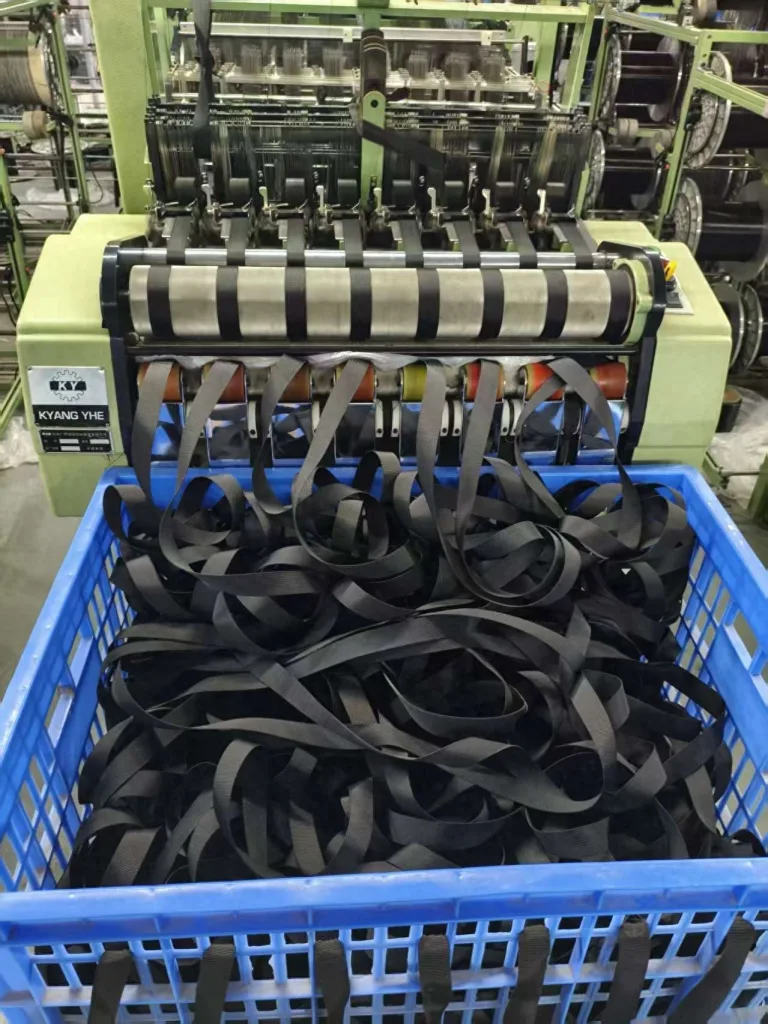
The moment we opened the door, the sound of dozens of webbing machines operating at the same time rushed toward us—rapid, dense, and rhythmic:
Clatter, clatter, clatter.
Rows of yarn entered from the upper part of each machine.
After being interwoven through hundreds or thousands of movements, webbing in different colors slowly emerged from the other side.
I stood at the entrance of the workshop and watched for a long time.
I would not describe it as shocking, but it felt strangely familiar.
The precisely rotating gears and cams, and the parts moving accurately along predetermined paths, followed principles similar to the equipment I had worked with at the metro company.
A webbing machine is, in essence, a piece of precision textile machinery.
Every movement contains a kind of mechanical beauty.
▸ The Hands of an Experienced Craftsman
The person who impressed me most in the workshop was an experienced technician named Master Chen.
He was in his fifties, with gray hair and rough hands. He sat in front of a jacquard machine like a statue.
The machine in front of him was running at high speed.
From time to time, he reached out, lightly pinched the webbing at the outlet, looked at it, and adjusted a knob on the machine.
The entire process took less than two seconds.
I moved closer and asked:
“Master, how do you know what needs to be adjusted?”
Master Chen replied:
“By feel. I have done this for thirty years. Even with my eyes closed, I can tell when something is wrong.”
He handed me a newly woven piece of webbing.
“Feel this. It is a fraction of a millimeter looser than the previous one. The tension is insufficient. When a downstream customer uses it for binding a bag, it will wrinkle.”
I held it in my palm and touched it again and again.
To be honest, I could not feel any difference.
Master Chen smiled.
“There is no hurry. Take your time. University graduates learn quickly and think fast, but your hands still need to catch up.”
At that moment, I suddenly understood something:
Technical skill cannot be learned only from books.
It grows in the hands and in muscle memory.
It must be fed with time and repeated practice.
▸ Another Side of My Father
That afternoon, I followed my father around the workshop.
He greeted every worker, knew everyone by name, knew whose child had just started school, and knew who had recently been unwell.
A young female worker had difficulty threading yarn.
He walked over, solved the problem in a few movements, and showed her a small technique at the same time.
That afternoon, I saw a completely different side of my father.
At home, he did not talk much. After dinner he usually looked at his phone and occasionally argued with my mother about small things.
In the factory, however, he was entirely different—energetic, sharp-eyed, and fast-moving.
When speaking with customers on the phone, he sounded calm and confident and refused to give ground on important terms.
I suddenly remembered visiting the accessories market in Shiling with him when I was a child.
At that time, he was still a junior salesperson.
Every day, he carried sample bags from factory to factory and visited customers one by one.
I remembered that when he returned home, his shoes were often worn out of shape and the soles of his feet were covered with blisters.
He never complained about being tired.
Whenever he returned from a business trip, he always brought me a small snack.
From a junior salesperson to an independent sales manager, then to an accessories trader and finally the founder of Huayun Manufacturing—how had he completed that journey of more than twenty years?
The answer was simple:
One step at a time.
There was no shortcut and no sudden stroke of luck, only persistence day after day.
Now it was my turn to walk that road.
▸ On the Metro Back to the City
The metro ride from Shiling back to the city took more than an hour.
I leaned against the seat, closed my eyes, and heard the sound of the webbing machines in my mind:
Clatter, clatter, clatter—like a song without an ending.
My phone vibrated.
A colleague had sent a message:
“Tomorrow’s shift schedule is ready. Your Wednesday night shift has been moved to Friday.”
I replied:
“Received.”
Then I locked the screen.
The darkness outside the window rushed backward.
My own face was reflected in the glass—twenty-four years old, working at a metro company, with a stable state-owned-enterprise job and a visible future.
So why did I feel no excitement at all?
That night, after returning to the dormitory, I wrote a sentence in the notes app on my phone:
“If I am still photographing rust spots in the metro ten years from now, I will regret not being brave today.”
Chapter Three: The Hardest Dinner
Before the 2025 Spring Festival, I finally made my decision.
You may not believe it, but the thing that truly pushed me to decide was very small.
I was carrying out a routine inspection in the metro station.
I looked down at the dust on my hand, and a thought suddenly appeared:
Ten years from now, would I still be doing exactly the same thing?
What affected me even more was that my father sent me several photographs during that period.
In the pictures, he was working overtime alone in the workshop, adjusting a newly arrived jacquard machine.
The photographs were casual, but I noticed one detail:
He had more white hair than the last time I had seen him.
I enlarged the photographs and looked at them carefully for a long time.
He was bent over, examining a detail on a sample.
The lighting was dim, and his long shadow stretched across the floor of the empty sample room.
At that moment, I suddenly realized that my father was no longer the all-powerful parent I had imagined as a child.
He could become tired.
He could grow old.
He also needed help.
If he could no longer carry everything alone, should I, as his son, step forward?
▸ Telling My Parents
On Lunar New Year’s Eve, after the family dinner, we sat in the living room watching the Spring Festival Gala.
I took a deep breath and began to speak.
I said:
“Dad, Mom, I have something to tell you. I want to resign from the metro company and go to the factory to learn how to make webbing.”
The living room was silent for about three seconds.
Those three seconds felt longer than any night shift I had ever worked.
My mother said:
“What did you say? Say it again.”
I replied:
“I said I want to go to Huayun and learn webbing production.”
My mother suddenly stood up, and the orange in her hand fell to the floor.
“Have you lost your mind? So many people compete for jobs at the metro company, and you want to throw yours away? You want to make webbing? What future is there in webbing?”
She fired questions one after another, her voice becoming louder.
I lowered my head and said nothing.
My father remained silent.
He sat on the sofa changing television channels with the remote control.
His eyes were on the television, but I could tell he was not watching it.
After a long time, he finally spoke.
“Have you thought it through?”
I replied:
“Yes.”
My father said:
“Then that is enough. But understand this first: when you come to the factory, you will be an apprentice. You will be no different from anyone else. I will manage you the same way I manage everyone. If you cannot handle it, you will come back.”
My mother froze, opened her mouth, but finally said nothing.
She turned and went into the kitchen.
A little later, she brought out a plate of fruit and placed it heavily on the coffee table.
I later learned that she secretly cried in the bedroom that night.
It was not because she was angry.
It was because she felt sorry for me and believed her son was choosing a difficult life.
Some roads are destined to make the people who love you worry first.
But if you are not willing to take responsibility for your own choice, how can you expect anyone else to trust you?
▸ My Colleagues Could Not Understand
When the news spread, my colleagues at the metro company reacted in different ways.
Most of them said it was a pity.
A few close friends supported me, although they still made jokes.
Colleague Wang said:
“Are you sure you did not drink something strange on New Year’s Eve? You are giving up such a good job to make webbing? I do not even know what webbing is.”
I replied:
“Webbing is… never mind. You will understand one day.”
Colleague Zhang said:
“I understand you, brother. Young people want to try things. But remember one thing: you can take risks, but leave yourself a way back.”
I remembered his words.
Later, when I encountered difficulties at Huayun, I did think about a way back.
But each time, I asked myself another question:
If you begin the journey by thinking about retreat, what is the purpose of taking the road at all?
On the day I submitted my resignation, the woman in human resources looked at me as though I were mentally unwell.
“Young man, think again. Do you know how difficult it is to obtain a secure position in a state-owned company these days?”
I smiled and said I had made my decision.
She sighed and completed the formalities.
When I walked out of the company entrance, the sunlight was bright.
I stood there, took a deep breath, and turned toward the metro station.
It was the final time I would ride that line as an employee.
Chapter Four: The Days as an Apprentice
In March 2025, I officially left the metro company.
After handing over my final responsibilities and returning my employee card and uniform, I stepped out of the metro station.
The spring wind blew toward me, and the world suddenly seemed brighter.
One week later, I stood at the entrance of Huayun’s factory with a suitcase.
▸ The First Day: Starting from Zero
I still remember my first day clearly.
I walked into the workshop wearing new jeans and a white T-shirt.
By noon, both had been covered with machine oil and dust.
There was a black oil stain on the knee of my jeans, and several colored yarn ends were stuck to my white shirt.
Master Chen looked at my appearance and, unusually, laughed.
“University graduate, do not wear white clothes here again.”
The next day, I changed into old, dark-colored clothes.
I later discovered that when working in a webbing factory, clothing comes in only two suitable colors:
Dark, or darker.
My father gave me no special treatment.
He led me into the workshop, pointed to a table, and said:
“Your workstation is there. Starting today, learn from Master Chen.”
Master Chen was the experienced technician I had seen during my previous visit.
He looked me up and down and asked:
“Have you ever worked with a webbing machine?”
I replied:
“No, but I have maintained equipment before. I should learn quickly.”
Master Chen said:
“You have worked with equipment? Good. I will first explain the basic structure of a webbing machine. Follow me.”
For the entire first week, he did not allow me to touch anything.
He made me stand beside the machines and watch:
How he threaded the yarn, checked the tension, adjusted the heddle frames, and joined broken yarn.
I watched for eight hours a day for one week.
I asked:
“Master, when can I begin doing it myself?”
He replied:
“Why are you in such a hurry? You do not even understand what you are watching. If you start now, you will just break the yarn.”
He was right.
Once a webbing machine begins operating, yarns interweave hundreds of times per minute.
A tiny mistake—one yarn threaded incorrectly or a tension setting one mark away—can ruin the entire length of webbing.
It was not like repairing metro equipment, where a loose screw could simply be tightened.
Webbing is an integrated structure.
When one part goes wrong, the output from the entire production line can become unusable.
▸ My First Attempt: A Disaster
During the second week, Master Chen finally allowed me to begin.
My first task was threading:
Passing hundreds of yarns through the heddles and reed in the required sequence.
It sounded simple.
Only when I began did I understand how difficult it was.
Hundreds of yarns, each as fine as hair, had to pass through the correct position.
If one yarn was threaded incorrectly, the woven pattern would be wrong.
I worked for the entire afternoon until my eyes blurred and red marks appeared across my fingers.
I had completed less than one-third of the work.
Master Chen came over, looked at it, and shook his head.
“Three yarns are wrong. Remove them and start again.”
That afternoon, I removed and rethreaded the yarn four times before finally completing the setup.
When the webbing machine started, a smooth, even, brightly colored strip slowly emerged.
My hands were shaking, but I felt a sense of certainty I had never experienced before.
Master Chen picked up the piece of webbing, held it toward the light, and nodded.
“It is acceptable. It can be used.”
For an experienced craftsman, “it can be used” was probably the highest praise he was willing to give.
▸ The Edges That Were Slowly Worn Away
When I worked at the metro company, I wore a clean uniform and sat in an air-conditioned office, typing on a computer.
At Huayun, my daily life became very different.
I arrived at the factory at 7:30 every morning.
First, I checked the condition of the machines.
Then I began threading yarn, adjusting equipment, and checking samples.
Once the machines were operating, I had to monitor the tension continuously and record the data every thirty minutes.
If I found frayed edges, skipped yarns, or color differences, I had to stop the machine immediately and investigate.
By the end of the day, back pain and aching muscles were normal.
My hands always carried marks from the yarn and traces of machine oil.
The sampling process frustrated me most.
A customer would send a sample and ask us to reproduce it.
The color had to match, the width had to be accurate, and the pattern could not deviate.
The first time I independently prepared a sample, I spent two full days adjusting the machine and wasted six or seven lengths of webbing before producing one that was barely acceptable.
The customer looked at it and said:
“It is close, but the color is slightly too dark. Adjust it again.”
At that moment, I understood how a tiny difference could lead to a major consequence.
In the webbing industry, “slightly” can mean that an entire batch may be rejected.
Another experience was even worse.
I was responsible for four machines that day.
One jacquard machine suffered a yarn break while operating.
Normally, the machine should be stopped immediately, the break located, and the yarn reconnected.
But I was dealing with a problem on another machine and did not notice the alarm.
By the time I discovered it, the jacquard machine had been running empty for almost ten minutes.
All the previous threading work had become useless and had to be removed and completed again.
I worked alone in the workshop until eleven that night.
When I finished threading the final yarn, my hands were completely numb.
I walked out of the factory.
The street was empty, and the streetlights stretched my shadow across the ground.
At the metro company, a mistake usually meant repeating the work.
In a factory, a mistake means a direct financial loss.
That pressure forces you to take every detail seriously.
▸ The First Time a Customer Scolded Me
During my third month as an apprentice, my father allowed me to communicate with a customer independently for the first time.
It was a small outdoor-backpack brand that needed nylon webbing for backpack shoulder straps.
The order was not large—5,000 meters—but the customer had specific requirements for colorfastness and tensile strength.
I prepared a sample according to the requirements, checked it three times, decided there was no problem, and sent it to the customer.
Three days later, the customer called.
“What is wrong with this webbing? The colorfastness does not meet the requirement at all. I rubbed it twice with a wet cloth and the color came off. Did you carry out any testing?”
The voice on the phone was loud.
My hand trembled slightly as I held the phone.
I did not know how to respond and could only apologize repeatedly.
After the call, my father came over.
He did not scold me.
He took the sample, placed it on the inspection table, and performed a standard colorfastness test.
The result was obvious:
It did not meet the requirement.
My father said:
“Look. The problem is here. The colorfastness of this yarn batch is half a grade lower than the previous batch. When purchasing yarn, remember that every incoming batch must first be tested with a small sample. Only after it passes can it be used for bulk production.”
He paused and added another sentence:
“Remember, it is not frightening when a customer scolds you. What is frightening is when the customer says nothing and leaves. If a customer is willing to complain, it means you still have an opportunity.”
That night, I remade the sample and tested it five times.
Only after confirming that every indicator met the requirement did I nervously send it again.
Three days later, the customer replied:
“This batch is acceptable. We will place the order.”
When I saw the message, I released a long breath.
It was the first order I had secured independently.
The process had been difficult and I had been scolded, but the sense of achievement was something I had never experienced during my time at the metro company.
Chapter Five: A Different Kind of Advantage
If the first three months were a period of constantly being tested, then in the fourth month I finally began to find my own rhythm.
That rhythm came from the equipment-maintenance experience I had gained at the metro company.
▸ The Temperamental Jacquard Machine
The factory had an old jacquard machine that my father had purchased second-hand from another factory.
It had one persistent problem:
Every two or three hours, the woven pattern suddenly shifted out of position.
Master Chen adjusted it based on experience each time, but the same problem always returned.
One day, when Master Chen was away, the machine developed the problem again.
I crouched beside it and watched for a long time.
I suddenly noticed a detail:
Just before the pattern shifted, the camshaft produced a faint clicking sound.
I recorded a video with my phone, played it in slow motion, and watched it repeatedly.
I discovered that at one particular angle, the camshaft paused for a tiny fraction of a second.
The pause was extremely small, but it was enough to change the lifting timing of the heddle frame and cause the pattern to shift.
I had found the problem:
The camshaft bearing was worn.
I told my father.
He was doubtful, but opened the cam box to inspect it.
Two balls inside one bearing had broken.
After replacing the bearing, the machine never produced the same pattern fault again.
Master Chen said:
“You are better than I expected. I worked on this problem for two months and could not find it. You recorded two videos and solved it?”
I replied:
“Master, I accumulated a lot of equipment-maintenance experience at the metro company. I did not expect it to become useful here.”
My father stood nearby.
The corner of his mouth lifted slightly, but he quickly returned to his usual serious expression.
That was the first time after joining Huayun that I truly felt the value of professional knowledge.
It is not a diploma.
It is a way of examining problems.
▸ The Equipment-Improvement Plan
After that success, I began deliberately using systematic equipment-maintenance thinking to examine every machine in the factory.
The warp-feeding system of the webbing machines, the tension control of the take-up mechanism, and the electronic-control system of the jacquard machines all appeared to have room for improvement.
I spent two weeks giving every machine a complete “health examination.”
I organized operating parameters, lists of consumable parts, and historical maintenance records into a spreadsheet.
I also marked which components required regular replacement and which mechanisms contained design weaknesses.
When I handed the report to my father, he read it several times and remained silent for a long time.
Finally, he said:
“This information is valuable.”
From then on, my role in the factory began to change.
I was no longer only an apprentice.
I also took responsibility for part of the equipment maintenance and process improvement.
I began giving basic equipment training to other workers, teaching them how to recognize bearing wear, listen for abnormal gear noise, and identify motor overload.
Master Chen did not say much, but I could see his attitude changing.
At first, he thought I was a university graduate with high expectations but little practical ability.
Later, he began to think that I might genuinely understand something.
Once, he even asked me to discuss the selection of a new machine with him.
Between an experienced master and an apprentice, that was almost unprecedented.
“Knowledge is never wasted. It simply waits for the right moment to become useful.”
▸ A Small Attempt at Automation
At the metro company, I had encountered some industrial-automation systems.
After joining Huayun, I discovered that automation in the webbing industry was generally limited, and many processes still depended heavily on manual operation.
Tension adjustment was one example.
Workers manually turned control knobs to adjust tension, which was inefficient and inconsistent.
I proposed an idea to my father:
Install tension sensors and automatic-adjustment devices on key machines.
Workers would no longer need to watch the controls continuously.
The system could adjust itself according to real-time tension data.
After listening, my father asked a very practical question:
“How much will it cost?”
I calculated that one modification would cost approximately RMB 3,000 to 5,000.
For a webbing machine, the investment was not especially large.
My father said:
“All right. Modify one machine first. If it works, we will discuss the others.”
I spent almost one month finding suppliers, purchasing parts, drawing circuit diagrams, and writing the control program.
Finally, I completed the modification on the oldest webbing machine in the factory.
During the first test, everyone in the workshop gathered around to watch.
When the machine started, the tension-sensor values changed on the screen, and the automatic device continuously made small adjustments.
The tension uniformity of the finished webbing improved by at least 30 percent.
Master Chen picked up the webbing, felt it with his hand, said nothing, and raised his thumb.
That was the moment when I felt the strongest sense of achievement after joining Huayun.
It was not simply because I had modified a machine.
It was because I had finally proved that my choice was not wrong.
The equipment-maintenance experience I had gained at the metro company had not been wasted.
It had simply needed a place where it could create real value.
Chapter Six: Doubt and Recognition
Growth is never linear.
Just when I felt that I was beginning to understand the work, reality taught me another lesson.
▸ A Major Order That Nearly Went Wrong
In the summer of 2025, Huayun received a relatively large order.
A well-known outdoor brand needed 30,000 meters of elastic webbing for the adjustment systems of sports backpacks.
The order was extremely important to Huayun.
If we completed it successfully, we might become a long-term supplier to the brand.
My father assigned the sample development and production coordination to me.
It was the first time I had taken responsibility for an order of that size.
I was both excited and nervous.
The sampling stage went smoothly.
The customer approved the sample and placed the formal order.
The problem appeared during production.
Elastic webbing requires extremely strict control of recovery performance.
After our machines produced approximately 2,000 meters, the elasticity began to fluctuate.
Some sections were too firm and others too soft.
I spent three days investigating the cause.
Finally, I discovered that changes in workshop temperature and humidity were affecting the elasticity of the yarn.
During summer afternoons in Guangzhou, the workshop temperature could rise to forty degrees Celsius, while the humidity changed significantly.
Elastic yarn is highly sensitive to those conditions.
For every five-degree increase in temperature, elasticity could decrease by approximately three to five percent.
The solution was to install constant-temperature and constant-humidity equipment.
But the investment was substantial.
A complete industrial air-conditioning system was quoted at more than RMB 100,000.
For a small factory that had only recently been established, it was not a small amount.
I said:
“Dad, if we do not solve this, we will not be able to handle future large orders. Elastic webbing is one of our development directions. We will have to invest in temperature control sooner or later.”
My father replied:
“I know. But there is not much cash available at the moment. Taking out more than one hundred thousand yuan at once would create a lot of pressure.”
That evening, my father and I sat in the factory office for a long time.
Finally, he said:
“We will do it in two stages. First, spend twenty thousand yuan on several portable air conditioners and dehumidifiers to stabilize the temperature and humidity around the core production lines. After we receive payment for this order, we will install the complete system.”
Once the plan was decided, I adjusted the production schedule overnight.
All elastic-webbing production was arranged from early morning to noon, when the workshop temperature was lowest and most stable.
We also installed a simple temperature-and-humidity monitoring system and recorded the data every fifteen minutes.
In the end, the goods were delivered on time and passed all quality inspections.
But the anxiety of those days taught me something important:
In manufacturing, solving production problems is only a basic skill.
The real challenges often appear in places no one expected.
▸ My Mother’s “Surrender”
The weekend after completing the major order, I went home for dinner.
My mother cooked braised pork ribs, one of my favorite dishes.
The atmosphere at the table was much more relaxed than it had been during the Spring Festival.
While we were eating, my mother suddenly said:
“Son, you are darker and thinner.”
I smiled.
“The workshop is hot, and the work is tiring.”
She said nothing more and quietly placed a piece of pork rib in my bowl.
After a while, she asked softly:
“Are you… adapting to the factory?”
I understood the meaning behind the question.
She was not asking how much technical knowledge I had learned.
She was asking whether I regretted my choice.
I replied:
“Mom, it is good. It is tiring, but I learn something new every day. It is much more interesting than working at the metro company.”
She said:
“Mm.”
Then she lowered her head to continue eating.
But the corners of her mouth lifted slightly.
My father later told me that during the Spring Festival, she had called him every day and asked:
“How is the factory?”
“Is the child tired?”
“Has he been injured?”
She criticized me openly, but inside she worried more than anyone.
Sometimes this is how parents express love.
Their words may be strict, but their hearts understand everything.
Chapter Seven: What Webbing Taught Me
After spending more than half a year at Huayun, I gradually discovered that learning webbing production had taught me far more than technical skills.
▸ Patience: The First Lesson from Hundreds of Yarns
Threading was the first process I learned, and it remains the process I fear most.
Not because it is technically difficult, but because it requires an extraordinary level of patience.
A jacquard machine may use anywhere from several hundred to more than one thousand yarns.
Every yarn must pass through a specified heddle and reed opening.
The order cannot be wrong, and the tension cannot vary.
After threading is complete, every yarn must be checked individually to ensure there are no omissions or crossings.
The first time I completed the threading independently, it took me one and a half days.
At the time, I thought I was extremely slow.
Later, while speaking with Master Chen, he told me that his first threading job took three days—even though his own master guided him step by step.
Master Chen said:
“This industry has no shortcuts. It does not matter if you are slow today. What matters is that each time you are a little faster than the last. When you have threaded your hundredth machine, you will suddenly discover that you became faster without knowing exactly when it happened.”
He was right.
By the time I had threaded my fiftieth machine, I was three times faster than during my first attempt.
No one had taught me a secret.
My hands had naturally remembered the force, angle, and rhythm of each movement.
Patience is not a quality created by forcing yourself through willpower.
It slowly becomes part of the body through hundreds and thousands of repetitions.
▸ Respect: Every Yarn Has Its Own Character
Many people believe that webbing production is simply “weaving yarn into a strap.”
Only after joining Huayun did I understand how much knowledge the work contains.
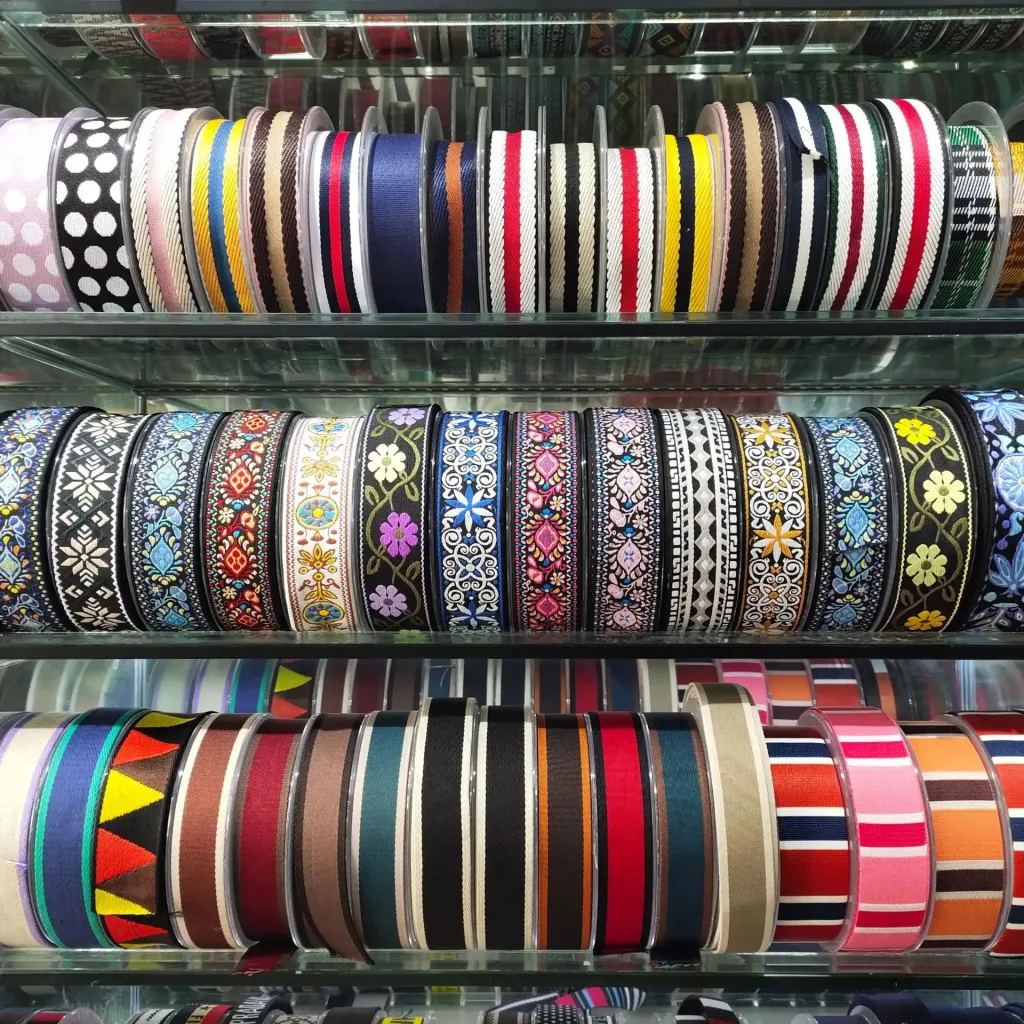
There are dozens of yarn types:
Nylon, polyester, polypropylene, cotton, elastic yarn, PP yarn, and many others.
Each one has different tensile strength, dye absorption, and temperature resistance.
Even the same yarn can vary between suppliers and production batches.
Yarn from the same batch can also behave differently under different temperature and humidity conditions.
Once, a supplier changed to a different yarn mill.
The new yarn was twenty percent cheaper than the previous material.
I calculated the saving and decided to use it.
The finished webbing, however, differed from the approved sample by one color shade.
The customer rejected it during inspection.
The loss was far greater than the money I had saved on raw materials.
My father said:
“Remember, there is no ‘close enough’ in the webbing industry. A difference of one millimeter is still one millimeter. A difference of one color shade is still one shade. Customers spend real money. If you give them ‘close enough,’ they will not return next time.”
From then on, I developed greater respect for every yarn, every raw-material batch, and every machine.
In this industry, “close enough” is one of the most dangerous phrases.
▸ Focus: Doing One Thing for Eight Hours
When I worked at the metro company, I was accustomed to multitasking—working, replying to messages, and talking with colleagues at the same time.
At Huayun, that habit almost caused serious problems.
When a webbing machine is operating, it requires continuous monitoring.
It is not enough to look occasionally.
Tension data, operating sounds, and the surface quality of the webbing must all be watched without interruption.
Neglecting one small detail can cause an entire batch to become unusable.
I still remember something Master Chen said:
“Watching a machine is like watching a child. The moment your attention leaves, it creates trouble.”
After working at Huayun for a long time, I realized that I had changed.
In the past, I checked my phone whenever it made a sound.
Now I can work for several hours without looking at it.
I used to be unable to remain still.
Now I can crouch beside a machine and observe it for two or three hours.
This improvement in concentration did not come from deliberate training.
The environment forced it.
If you do not focus, you pay a direct price.
Sometimes I wonder whether much of the anxiety in modern society comes from losing the ability to focus on one task.
We constantly do many things at the same time, yet rarely do one thing exceptionally well.
“Webbing taught me that real speed comes from complete concentration.”
Chapter Eight: Looking Back After One Year
In the spring of 2026, I had been at Huayun for exactly one year.
That day, I stood in the workshop, looked at the rows of webbing machines operating in an orderly rhythm, and listened to the familiar clattering sound.
It felt as though a lifetime had passed.
One year earlier, I had stood at the factory entrance with a suitcase and uncertainty in my heart.
Now I could independently manage three production lines and communicate with four or five customers at the same time.
▸ What I Learned
Technical skills: I can independently complete the full process, including yarn threading, machine adjustment, sample preparation, quality inspection, and equipment troubleshooting.
I am still far behind an experienced technician such as Master Chen, but at least I am no longer the newcomer who understood nothing.
Management: I began participating in the factory’s daily operations, including production scheduling, inventory management, and cost calculation.
I discovered that managing a manufacturing company is much more complicated than it appears.
Every stage is connected.
When one stage fails, the entire supply chain may be affected.
Market knowledge: I visited more than ten customers with my father and attended two industry exhibitions.
I developed a clearer understanding of competition in the webbing market.
I even began writing customer proposals.
I combined the logical communication skills I had developed through project reports at the metro company with professional terminology from the webbing industry and produced a reasonably effective product presentation.
▸ Changes in the Factory
During that year, Huayun was also changing quietly.
Equipment: I led the improvement of the tension-control systems on five webbing machines and installed basic temperature-and-humidity monitoring equipment.
Production-line stability improved significantly compared with the early days of the factory.
People: The factory hired two younger workers, and I became responsible for training them.
When I watched them stand uncertainly beside the machines, I saw myself from one year earlier.
The first lesson I taught them was the same one Master Chen had taught me:
Watch first and do not rush.
Business: After completing the large order for the well-known outdoor brand, another two or three brands contacted Huayun directly.
My father often says:
“Quality is the best salesperson.”
I used to hear the words without fully understanding them.
Now I truly believe them.
▸ The Old Employee Card
One day, while organizing my dormitory room, I found my old metro-company employee card in a drawer.
It had a blue background, and the photograph had been taken when I first joined the company.
I looked young and inexperienced.
I held the card and looked at it for a long time.
Did I regret leaving?
No.
If I had not resigned, I might now have been promoted one grade.
My salary might have increased slightly, and life would still have been stable.
I would still repeat the same rhythm every day, occasionally meet friends for dinner on weekends, and live a calm life like plain water.
But I would not know how a webbing machine operates.
I would not know that a single yarn can become thousands of patterns.
I would not know that the clattering sound of machinery could make a person feel so calm.
I would not know how rough Master Chen’s hands are, how much white hair my father has, or how many times my mother cried quietly.
Most importantly, I would never have known that after stepping outside a comfort zone, the world can be much larger than expected.
I placed the employee card in the deepest part of the drawer.
It was not a rejection of the past.
It was a farewell to it.
The young man in the blue metro uniform had become a webbing worker wearing oil-stained clothes, with yarn marks across his hands.
No road in life is walked for nothing.
The metro taught me stability and responsibility.
Huayun taught me passion and courage.
Both experiences together created the person I am today.
Epilogue: To Everyone Who Is Still Hesitating
As I write this article, I am on duty in Huayun’s workshop.
Outside the window are the noisy streets of Shiling Town.
Beside me is the endless sound of webbing machines operating.
If you ask me whether it was worth giving up a secure metro job to learn webbing production, my answer is yes.
But that value cannot be measured only in money.
During this past year, my income was indeed lower than it had been at the metro company.
But the things I learned, the experiences I gained, the people I met, and the growth I felt cannot be purchased with money.
I learned patience.
After threading hundreds of sets of yarn, the things in life that require waiting no longer feel so difficult.
I learned concentration.
My old inability to sit still has almost disappeared.
Giving your full attention to one task is itself a form of happiness.
I learned to face failure.
Customers criticized me.
My master corrected me.
I nearly failed an order and produced unusable products.
Those experiences once made me doubt myself, but when I look back now, each failure was an opportunity to grow faster.
Most importantly, I found the feeling of truly being alive.
Instead of following the same routine, clocking in and clocking out every day, I now do work that feels meaningful.
Every day I improve.
Every day contains uncertainty and possibility.
Perhaps you are also wondering whether to step outside your comfort zone.
Perhaps you feel anxious about a job that looks good from the outside but leaves you dissatisfied inside.
Perhaps you also ask yourself late at night:
Is this all my life will ever be?
I cannot tell you what you should do.
Everyone’s circumstances are different, and every person’s choice deserves respect.
But I can share one principle that I learned at Huayun:
“Webbing is woven one yarn at a time, and a road is traveled one step at a time. You do not need to see the entire future. Begin by taking the first step.”
My father often tells me:
“Running a factory is not a short-term business. It is a long-term journey. Losing a little today is not frightening. As long as the direction is right, it can be earned back in the future.”
Life is the same.
Today, every day at Guangzhou Huayun Manufacturing Co., Ltd. feels full.
I arrive in the morning, inspect equipment, arrange production, communicate with customers, learn new technology, and train new workers.
It is busy but meaningful.
At night, after returning to the dormitory, I sometimes read technical information about equipment maintenance and think about what else can be improved.
I discovered that when you truly love something, learning is no longer a burden.
It becomes a form of enjoyment.
A few days ago, Master Chen told me that my threading speed had already reached the level he had when he was young.
I laughed and asked:
“Then when will I reach your current level?”
He thought for a moment and replied:
“Work another twenty years.”
Twenty years sounds like a long time.
But my father has already worked in the accessories industry for more than twenty years.
He began as a junior salesperson and eventually founded Huayun Manufacturing.
Even today, he is still the first person to arrive at the factory and the last person to leave.
It is not because he has no other choices.
He genuinely loves the work.
Perhaps one day, I will become someone like him—wearing work clothes, standing beside a webbing machine, gently pinching the webbing with callused hands and immediately knowing whether it meets the standard.
How far away is that day?
I do not know.
But I am already on the road.
· · · · · · · · · · · · · · · ·
Written in Shiling Town, Huadu District, Guangzhou
Guangzhou Huayun Manufacturing Co., Ltd. · April 2026
Thank you to everyone who took the time to read this story.
Company Information
Full Factory Name
Guangzhou Huayun Manufacturing Co., Ltd.
Head Office Address
Shiling Town, Huadu District, Guangzhou, China — the Leather Goods Capital of China
Main Business
Research, development, production, and customization of webbing, zippers, and bag accessories.
The main products include nylon webbing, polyester webbing, cotton webbing, PP webbing, jacquard and printed webbing, binding tape, elastic webbing, nylon zippers, metal zippers, resin zippers, zippers for bags, precision bag hardware and buckles, customized development, volume production, and one-stop accessory sourcing services.
Cooperation and Contact
For customized webbing, zippers, or bag accessories, please contact us through the website form, WhatsApp, WeChat, or email.
We support customization based on physical samples, drawings, and specifications.