
Webbing is used in clothing, bags, footwear, outdoor equipment and safety products. It may look like a simple strip of narrow fabric, but anyone who has spent time working with yarn and looms knows how much goes into it. The finished product depends on the fiber, the weave, the dyeing process and the way the material is finished. A small change at any of these stages can affect the result.
The principle that “practice is the sole criterion for testing truth” has a direct meaning on the factory floor. A material choice has to be checked against the customer’s sample. A color match has to be assessed under the right light. Hand feel, thickness and weight have to be examined together. On a shuttleless loom operating at high speed, even a slight change in tension can show up in the finished webbing. Reliable quality comes from testing these details, recording the results and paying attention to what actually happens in production.
1 Identifying the yarn before production
The first task in developing a webbing product is to understand the yarn in the reference sample. It is tempting to look at a short piece of webbing, feel it between the fingers and decide that it must be polyester or polypropylene. That assumption can be expensive. Once the wrong material has been ordered and woven, the finished batch may differ substantially from what the customer expected.
Synthetic filaments can look similar while behaving quite differently. Nylon 6 and Nylon 66 offer good abrasion resistance and resilience, but they absorb more moisture than polyester. Polyester is valued for its dimensional stability, crease resistance and resistance to sunlight, although its stiffness and recovery differ from those of nylon. Polypropylene, or PP, has a low density, can float in water and is often economical. Its resistance to heat and sunlight needs particular attention when selecting it for an application.
Burn tests can provide useful clues. Nylon may produce an odor often compared with celery and leave a hard, rounded bead. Polyester commonly gives off a sweet, aromatic odor with dark smoke. These observations need to be considered alongside other checks. Yarn linear density, usually expressed in denier or D, twist level and suitable solubility tests all help establish what the sample is made from.
The form of the yarn matters too. Draw-textured yarn, or DTY, generally has a bulkier, softer feel. Fully drawn yarn, or FDY, is usually smoother and more compact; its strength must be confirmed from the actual yarn specification. Even within one fiber type, bright, semi-dull and full-dull yarns reflect light differently after weaving. Choosing the wrong yarn can therefore change both the appearance and the feel of the product.
At Guangzhou Huayun Manufacturing, we examine each incoming sample closely, even when the piece supplied is very small. Our technical team unpicks the webbing under magnification, counts the warp ends, checks the weft density and examines the filament fineness and fiber structure. This work gives production a reliable starting point. Weaving and finishing adjustments are much easier to make once the material has been correctly identified.
2 Assessing color under agreed lighting
Color differences are a frequent source of complaints in webbing production. One common reason is that the supplier and customer are judging the samples under different lighting. A production sample may appear to match the approved reference under an indoor lamp, then look redder or greener in daylight. Two samples that match under one light source but differ under another show what is known as metamerism.
The color we see depends on the dye formulation and the light falling on the material. Before dyeing begins, we need to establish where the webbing will be used and which lighting conditions the customer requires for approval. D65 is commonly used to simulate daylight. TL84 and CWF provide specified fluorescent lighting conditions for commercial environments, while illuminant A represents incandescent lighting. UV assessment may also be needed for fluorescent or other special effects. The customer’s agreed requirements should determine which sources are used.
An informal judgment under ordinary workshop lighting is not enough for a controlled color approval. The base whiteness of the yarn, the pigment masterbatch, moisture content and the dyes used can all affect the final shade. A change in the raw material batch may also change the way a color behaves under different lights, even when the dye recipe is unchanged.
A standard light booth gives inspectors a consistent setting for comparison. During lab-dip approval and production inspection, the webbing is placed beside the customer’s approved reference or the specified Pantone standard. Inspectors compare the samples under the agreed sources, including D65, TL84, CWF and, where required, U30 or other installed lamps. A consistent viewing angle, commonly 45 degrees, helps make the assessments comparable. The aim is to detect differences in hue, lightness and saturation and confirm that the match remains acceptable under the lighting conditions that matter to the customer.
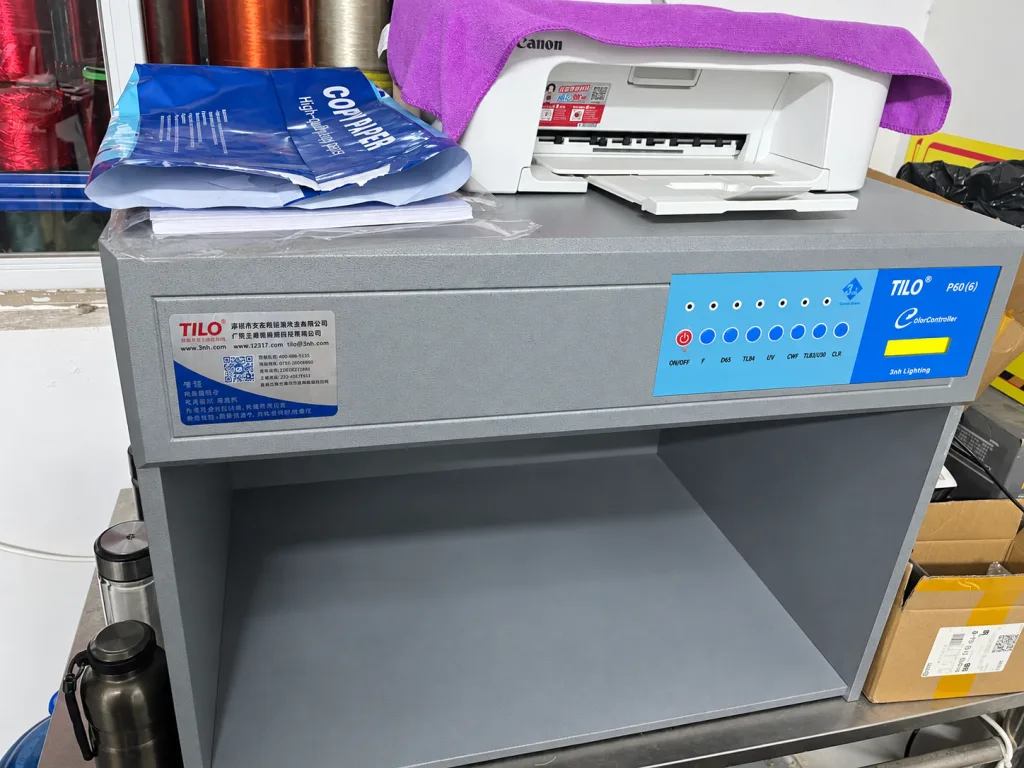
3 Keeping samples and production records
Webbing production draws on accumulated experience, and that experience is most useful when it is recorded. For an established factory, folders of retained samples and batch records are valuable working tools. At Guangzhou Huayun Manufacturing, we treat these records as part of the foundation of quality control.
A customer may place a repeat order months or years after the first delivery. Without clear records, it can be difficult to recover the original yarn specification, warping tension, loom settings or dye and auxiliary recipes. The result may be a noticeable change in shade or hand feel. A properly maintained file lets the quality and production teams retrieve the customer’s original sample, the lab-dip recipe, development samples and the approved sample from bulk production by order number.
Those records allow the team to return to the proven settings and compare the new batch with the earlier one. They also give inspectors a practical reference when checking whether the repeat order meets the agreed requirements. Keeping the original sample and the production records together makes differences easier to investigate.
The archive is useful for new development as well. When an unfamiliar sample arrives, an experienced technician may recognize a yarn construction or shade related to an earlier job. The previous file then provides a starting point for selecting the yarn blend and dye combination. In a straightforward case, consulting the records may narrow down a workable approach within half an hour. Retaining the incoming sample, trial pieces and a cut length from the finished batch helps the next job benefit from work already done.

4 Controlling hand feel and interpreting thickness and weight
Customers often describe the hand feel they want in practical terms: the webbing should hold its shape without scratching the skin, or have enough body while remaining soft to the touch. Turning those descriptions into a repeatable product requires control of the weave, yarn tension and finishing process.
The weave is the starting point. Plain weave has frequent interlacings and tends to produce a firm, compact structure. Twill has longer floats and can feel softer, with a more pronounced surface sheen. Satin structures generally provide a smoother surface. The yarns used and the density of the weave still determine how these structures feel in a particular product.
Warping tension and the force used to beat up the weft must also work together. Excessive tension can leave the webbing tight and hard, while insufficient tension may produce a loose structure with too little body. Small adjustments need to be checked against the approved sample rather than judged in isolation.
Finishing provides further control. Hydrophilic silicone softeners, lubricating agents and stiffening agents can be adjusted to achieve the required handle. Oven temperature and line speed affect how the fibers relax and how the finish is set. Where a process uses temperatures in the 160 to 190 degrees Celsius range, the setting must be selected for the fiber and finish concerned. The right combination can produce a smoother, firmer or fuller feel, depending on the intended use.
Thickness and weight need to be considered together. Customers sometimes find that one sample measures slightly thinner than another but weighs more. That is not necessarily a contradiction. When samples of the same width and length are compared, their weight depends on how much fiber is present, while their thickness also reflects the spaces between the yarns and the way the structure has been compressed.
A bulky piece of webbing may contain low-twist yarns or have a relatively open weave. The spaces between the fibers add thickness without adding much mass. A thinner piece may use tightly packed industrial filaments and a high weft density. Hot pressing or calendering can compress that structure further, reducing thickness while leaving a greater mass of fiber in the same area.
A compact construction made with suitable yarns can provide good tensile performance, but thickness or weight alone cannot establish strength. Inspectors need measurements of the relevant properties, including tensile performance where specified. Judging how much material is present simply by looking at the thickness can lead to the wrong conclusion.
5 Adjusting equipment throughout production
Shuttleless looms, computerized jacquard machines and finishing lines are central to modern webbing production. Their performance depends on how they are set up and maintained. Two machines of the same model can produce different results when the settings differ, so equipment adjustment is part of quality control throughout the job.
The reed count and the way the warp is threaded through the reed affect yarn distribution. The timing of the heald frames determines how cleanly the shed opens and can influence abrasion and surface hairiness. Uneven tension in the let-off system can produce wavy edges or sideways curvature. Changes to the take-up gearing alter the weft density, usually expressed as picks per inch or per centimeter. Temperature and humidity in the loom room can also affect static electricity and yarn tension.
The same attention is needed during heat setting and cutting. Uneven tension across the guide rollers can cause twisting or curled edges after winding. A temperature shift of around 5 degrees Celsius may affect shrinkage or shade in a sensitive heat-setting process, so the acceptable range must be established for the material and checked during production.
A webbing technician therefore needs to understand both the material and the machine. Precision rulers, thickness gauges and fabric inspection magnifiers help the team check width, thickness and weave density against the reference sample. Repeated checks on the factory floor show whether an adjustment has worked and whether the process is staying within the agreed tolerances.
-1024x768.webp)
6 Respect for the people who do the work
Good manufacturing depends on attention to ordinary details. Identifying a yarn, assessing a shade, retaining a sample and adjusting a loom are all practical tasks. Together, they create a sound basis for quality. The principle that practice tests truth asks us to check our assumptions against the material in front of us and the results coming off the machine.
Guangzhou Huayun Manufacturing is based in Shiling, in Guangzhou’s Huadu District, a center for leather goods manufacturing. Our production checks and sample records support customers in the bag, apparel, outdoor and industrial sectors around the world. The care involved in this work is familiar to people in many other trades too. Materials researchers, machine technicians and business owners reviewing customer samples all spend time solving problems that may be invisible to the final user.
Business conditions can change, but the responsibility to make a dependable product remains. We respect the people who keep working carefully through those changes and who take pride in doing their job well. To our customers, colleagues and fellow manufacturers, we offer our thanks and wish you steady progress in the businesses you have worked so hard to build.