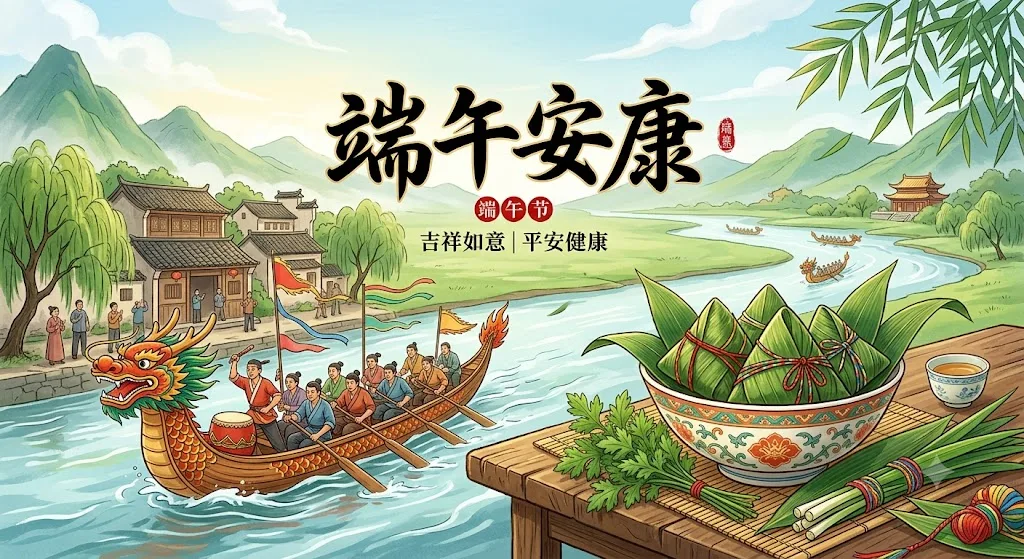
As the Dragon Boat Festival approaches each year, the air begins to fill with a comforting fragrance.
It is the aroma rising from a large iron pot, blending the freshness of tender zongzi leaves with the scent of soaked glutinous rice.
For Chinese people, eating zongzi has long gone beyond the physical meaning of food itself.
It is like an invisible bond. One end connects us to an ancient festival passed down for thousands of years, while the other is tied closely to the softest memories of home in every traveler’s heart.
Whether it is a rich and flavorful savory pork zongzi or a clean and delicately sweet alkaline zongzi, every bite carries a unique memory belonging to a particular region and a particular family.
During this traditional festival, we will avoid empty and exaggerated descriptions. Instead, we will begin honestly with the foods found in everyday life and take a closer look at six outstanding zongzi flavors that should not be missed this Dragon Boat Festival.
Let us see which one can truly satisfy your taste buds.
Recommendation One: Homemade Zongzi — Irreplaceable Sincerity and Generous Ingredients
Few people would disagree with placing homemade zongzi at the top of the recommendation list.
No matter how beautifully packaged the premium gift boxes outside may be, or how rare and expensive their ingredients may appear, they still cannot compare with zongzi wrapped by hand in a family kitchen.
Making zongzi at home is a warm family ritual in which everyone participates.
One or two days before the Dragon Boat Festival, the adults in the family begin preparing everything.
Freshly purchased reed leaves or bamboo leaves must be washed carefully one by one, then blanched in boiling water until they become green, flexible and strong.
The plump, round glutinous rice must be soaked several hours in advance and then drained.
When making savory zongzi, carefully selected pork belly must be marinated honestly and thoroughly with soy sauce and five-spice powder for an entire night.
On the day of wrapping, everyone gathers around a square table, folding leaves, adding rice, pressing the filling firmly and tying the zongzi with string. The movements become smooth and natural through years of practice.
Homemade zongzi never hold back on ingredients.
The meat is always cut into large pieces, and some families even add two large salted egg yolks.
When the large pot simmers in the kitchen for several hours, the entire home fills with a rich aroma carrying the effort, sweat and affection of the older generation.
With the first bite, the rice is sticky and tender, while the fat melts smoothly into it.
That steaming sincerity and abundance of genuine ingredients create a flavor that no commercial production line can ever reproduce—the finest taste in the world.
Recommendation Two: Zongzi from the Breakfast Shop Downstairs — The Most Familiar Taste of Everyday Street Life
If homemade zongzi represents family affection, then zongzi sold by the breakfast shop downstairs represents the warmth of ordinary street life and ultimate convenience.
Every morning, what wakes us early is often not the alarm clock, but the steam rising from the breakfast shop on the street.
When the lid of the large steamer or aluminum pot is lifted, thick white steam carries the rich, savory fragrance of zongzi leaves.
These zongzi do not come in luxurious gift boxes.
They are usually tied honestly with several pieces of cotton string. They are large, reasonably priced and filling.
For ordinary people rushing early to a market stall, a factory or to take their children to school, spending a few yuan on a hot zongzi from the shop owner is a simple and satisfying choice.
They skillfully peel away the leaves, hold the zongzi in a plastic bag and eat it while walking.
The glutinous rice has been steamed until completely soft, sticky and tender.
The savory pork filling contains both lean and fatty meat, and the fat has fully melted during the long cooking process, soaking into every grain of rice.
The texture is moist and smooth, while the salty fragrance of soy sauce is perfectly balanced.
This familiar neighborhood flavor is simple, convenient, generous and satisfying.
Steaming hot, it supports the dependable mornings of countless ordinary days.
Recommendation Three: Miluo Zongzi — Honoring the Origin of the Dragon Boat Festival with Traditional Alkaline Flavor
After discussing the foods found around us, we should turn our attention toward the deeper history of the festival.
The third recommendation must be zongzi from Miluo, Hunan, one of the places closely associated with the origins of Dragon Boat Festival culture.
The people of Miluo preserve their zongzi traditions with an ancient craftsmanship that is almost like a form of belief.
The most classic example of Miluo zongzi is the impressive traditional alkaline zongzi.
Its preparation is extremely particular.
High-quality local sticky glutinous rice is used, but the true soul of the recipe is the alkaline water used to soak the rice.
Traditional alkaline water is made by burning natural plants into ash and filtering the liquid. It is not produced with modern chemical additives.
The zongzi are usually wrapped into delicate triangular shapes.
After being slowly cooked for a long time in a traditional wood-fired pot, the finished zongzi develop an attractive golden-yellow color that is slightly transparent, almost like amber.
Miluo alkaline zongzi contain no complicated fillings.
Their appeal comes purely from the distinctive fragrance created by glutinous rice, natural alkaline water and zongzi leaves.
When eating one, people traditionally hold it with chopsticks and gently roll it in a bowl of white sugar until the surface is covered with sparkling sugar crystals.
The first bite is springy, pleasantly firm and chewy.
The freshness of the alkaline water perfectly balances the sweetness of the sugar, leaving a delicate plant-like aftertaste.
This bite is not only an exceptional pleasure for the taste buds. It is also one of the most authentic ways to honor thousands of years of Dragon Boat Festival culture.
Recommendation Four: Shunde Savory Pork Zongzi — The Culinary Capital’s Perfect Balance of Rich Fat and Mung Bean Flavor
For the fourth recommendation, we travel to Shunde, Guangdong, known as a “World Capital of Gastronomy.”
The people of Shunde are famous throughout China for the depth of their culinary knowledge and their extremely demanding standards for food.
Shunde savory pork zongzi perfectly reflect the wisdom of Shunde’s traditional cuisine in a festive food.
Cantonese savory pork zongzi can be found in many places, but the Shunde version stands out because of its carefully selected ingredients and distinctive golden ratio.
Shunde savory pork zongzi are usually firm and substantial.
After untying the straw string and opening the thick bamboo leaves, you will find that a large quantity of hulled mung beans has been mixed among the grains of rice.
The addition of mung beans is the defining feature of this zongzi.
The filling uses premium pork belly with clearly defined layers of lean and fatty meat, together with an entire carefully prepared salted egg yolk.
During the long cooking process, the fatty layer of the pork belly melts completely under the high temperature and releases its rich oil.
None of this fragrant pork fat is wasted.
Instead, it is absorbed like a sponge by the surrounding hulled mung beans and glutinous rice.
When eaten, the stickiness of the rice, the soft and powdery texture of the mung beans, the crumbly richness of the egg yolk and the smooth moisture of the fatty pork come together perfectly in the mouth.
The fresh, soft texture of the mung beans balances the richness of the pork fat, making the entire zongzi flavorful without becoming excessively greasy.
Every bite contains several distinct layers of texture and flavor, perfectly demonstrating the exceptional skill of Shunde cuisine.
Recommendation Five: Quzhou Zongzi — An Unconventional Spicy Flavor from Western Zhejiang
In many people’s traditional understanding, zongzi are either sweet or flavored with salty soy sauce.
The fifth recommendation, Quzhou zongzi, completely breaks through these familiar boundaries by focusing on an unconventional, satisfying and spicy experience.
Quzhou is located in western Zhejiang, and its local food culture is famous for the saying that no meal is complete without chili.
Naturally, the local zongzi also carry this bold and spicy character.
The most irresistible Quzhou varieties are the well-known pickled-mustard-and-pork zongzi and taro-and-pork zongzi.
Before wrapping, the glutinous rice is not only colored with dark soy sauce. It is also mixed with a distinctive local fresh chili sauce or dried chili powder, giving every grain of rice a slightly bright red appearance.
Instead of sweet red bean paste, the zongzi are filled with aromatic local pickled mustard greens stir-fried with diced native pork.
Another variation combines soft, powdery pieces of taro with rich pork belly.
After being cooked over high heat, the moment the leaves are opened, a spicy, slightly sour aroma rises immediately.
With the first bite, the softness of the glutinous rice is mixed with the crisp freshness of the pickled vegetables and the savory flavor of the diced meat.
A fresh but lingering heat then bursts rapidly across the tongue, immediately reviving an appetite weakened by the summer heat.
This distinctive combination of sourness, heat, freshness and savory flavor is bold, satisfying and exciting.
It provides an unforgettable taste experience for food lovers who have grown tired of traditional zongzi flavors.
Recommendation Six: Jiaxing Zongzi — The World-Famous “King of Zongzi” with Rich Soy Sauce and Tender Pork
The sixth and final recommendation is naturally Jiaxing zongzi from Zhejiang, famous throughout China and often regarded as the “King of Zongzi.”
As a traditional specialty from the waterways of the Jiangnan region, Jiaxing zongzi have almost become synonymous with Chinese pork zongzi.
The essence of Jiaxing zongzi lies in their rich soy-sauce flavor, tender pork and highly refined tradition of standardized production.
The classic Jiaxing large pork zongzi has a standard four-cornered pillow shape.
Its glutinous rice must be selected from high-quality late-season Jiangnan rice and fully marinated in a special aged soy sauce, allowing every grain to absorb the balanced salty and slightly sweet sauce.
The preparation of the meat filling is even more demanding.
A strict balance of lean and fatty meat is required, with one piece of fatty pork and one piece of lean pork paired perfectly together.
The zongzi must be simmered slowly in a large pot for a long period.
During this process, the fatty pork gradually melts completely.
Its original shape disappears, but its essence—the rich and fragrant oil—fully penetrates every grain of rice.
As a result, the entire zongzi develops a glossy, dark and richly moist appearance from the inside out.
The lean pork retains its clearly defined fibers and pleasant chewiness, with a flavor that is both savory and slightly sweet.
With one bite, the fragrance of soy sauce, meat and rice blends with the fresh aroma of the zongzi leaves and spreads throughout the mouth.
It is rich without being greasy, smooth, tender and soft.
This Jiangnan flavor uses soy sauce and fatty pork to their fullest potential and fully deserves its respected position as one of China’s most famous zongzi traditions.
Conclusion and Dragon Boat Festival Wishes: Weaving Festive Flavors and Carrying Peace to Every Home
From the first handful of rice filled with family affection in a home kitchen to the steaming atmosphere of an early-morning street market; from the amber-colored alkaline zongzi passed down for thousands of years beside the Miluo River to the distinctive combinations of richness and flavor created in Shunde, Quzhou and Jiaxing—each small zongzi uses only a few green leaves and a thin piece of string, yet it carries the Chinese people’s respect for life and weaves together the different flavors of happiness found in thousands of homes.
A single thread is twisted into a strong cord, and individual grains of glutinous rice are gathered into one complete zongzi.
Making zongzi requires genuine care, patience and attention to detail.
It is similar to the way we honestly operate a factory and work in physical manufacturing.
Only by taking every step carefully and steadily can we remain worthy of the trust placed in us.
As the Dragon Boat Festival approaches, the entire team of Guangzhou Huayun Manufacturing Co., Ltd. sincerely offers its warmest festival greetings to all customers, industry partners and friends who have trusted and supported us, as well as everyone working diligently in their respective positions.
We wish everyone a happy Dragon Boat Festival in advance!
While enjoying delicious zongzi, may you also experience the sweetness, warmth and stability of life.
May your days be as close and harmonious as sticky glutinous rice and continue rising toward greater prosperity.
May your body remain strong and healthy.
Wishing you peace and good health during the Dragon Boat Festival, as we carry the future forward together!