
In the massive textile, garment, and bag manufacturing industry, people often look at large areas of fabrics or leather main materials. However, what truly determines whether an article can be formed, whether it is durable, or even determines its aesthetic texture and brand added value, are often the skeletons and bonds hidden in the details—garment and bag accessories. Today, when we pull a smooth zipper, fasten a high-strength tactical webbing, or buckle an alloy fastener with a cold gleam, we enjoy the millisecond-level closure convenience brought by modern digital and intelligent industry. Looking back at the entire history of human creation, you will be surprised to find that the evolution of accessories is a miniature history of generational replacement of productivity tools. It evolved from primitive plant knotting and animal bone grinding in ancient times to silk ribbons and bronze belt hooks showcasing etiquette and ranks in feudal dynasties, to mechanical zippers and powered weaving under the baptism of the Industrial Revolution, and finally transformed into an all-in-one functional industry with the blessing of modern new materials and digital supply chains. The iteration of a single thread, a zipper, or a buckle reflects the firm steps of Chinese manufacturing moving from extensive OEM processing to high-quality modern smart manufacturing.
I. From Ancient Times to the Qin and Han Dynasties: From “Knotted Ropes and Ground Bones” for Survival Reinforcement to the Evolution of “Belt Hooks and Silk Ribbons” for Imperial Etiquette
The germination of accessories can be traced back to the primitive hand-weaving techniques of the Neolithic period for survival defense and basic reinforcement. In ancient times when humans had not mastered metal smelting or complex weaving technologies, to fix winter animal skins, prevent scattering, and reinforce carried tools like stone axes, ancestors began gathering plant phloem fibers such as kudzu vine and hemp, twisting them into primitive rope strands through interlocking knots. Meanwhile, they used polished animal and bird bones to craft primitive bone needles and bone hooks. This is the most primitive prototype of webbing and buckles in human creation history, serving purely basic physical survival connection functions.
Entering the Shang, Zhou, Qin, and Han dynasties, with the explosion of bronze smelting technology and the leap in silk weaving craftsmanship, accessories welcomed their first true historical leap in both function and aesthetics. During this period, narrow-width textile accessories (webbing) were often called “Tao”, “Dai”, or “Zu Shou” in ancient literature. Because the craftsmanship of manual “waist looms” and ancient “tablet weaving” was extremely tedious and silk yields were scarce, these colorful, intricately patterned silk woven bands became political symbols for dividing feudal official ranks and hanging imperial seals. Simultaneously, “bronze belt hooks” and “jade belt hooks,” the ancestors of metal hardware accessories, emerged. These bronze accessories used for waist belt connections featured exquisite casting craftsmanship, often engraved with Taotie patterns, dragon and phoenix motifs, and inlaid with turquoise or coated with gold and silver. At this time, accessories had completely detached from simple utility strapping, sublimating into the ritualistic and majestic aesthetic characteristics of the feudal ruling class.
II. The Tang, Song to Ming, Qing Dynasties: The Prosperity of Handicraft Workshops and the Decentralization of Urban “Ribbon and Button Guilds”
As history entered the prosperous Tang, Song, Ming, and Qing dynasties, the boom in commodity economy greatly stimulated the secular demand for high-quality footwear, apparel, and bags, leading accessories production to step out of state-monopoly workshops into broad civilian marketplaces. Huang Daopo’s improvement of cotton textile techniques in the Yuan Dynasty allowed high-quality, cost-effective cotton yarn to largely replace expensive silk, becoming the primary raw material for mass civilian weaving and rope bands.
During this period, the “foot-pedal manual wooden loom with shuttles,” capable of weaving multiple bands simultaneously, was widely utilized in civilian workshops across Jiangnan, sending production efficiency skyrocketing exponentially. In the Ming and Qing dynasties, towns like Suzhou, Hangzhou, and Huzhou saw the rise of civilian “ribbon guilds” and “button workshops” specializing in narrow trimmings, garment borders, waistbands, and handkerchiefs. The forms of accessories became unprecedentedly diverse: besides traditional silk bands, various frog buttons, copper belt buckles, shoe laces, and a dazzling array of embroidered ribbons on women’s attire emerged. The interlocking of countless accessories not only gave traditional Chinese attire a structured and functional foundation for closure, but honestly supported the exquisite flavor and daily vitality of Chinese urban life with subtle details.
III. The Modern Industrial Revolution: The Birth of the Modern Zipper and the Formation of the Modern Accessories Industry
The tranquility of traditional handicraft workshops was shattered by the thunderous roar of the mechanical Industrial Revolution in the 19th century. Along with the advancement of industrial machine manufacturing, apparel and bag closure devices welcomed a disruptive mechanical miracle—the birth of the zipper. In the late 19th century, American engineer Whitcomb Judson designed a “Clasp Locker” composed of a series of interlocking pins and iron hooks in 1893 to solve the trouble of unlacing long boots, which was the earliest ancestor of the zipper in modern times.
In 1913, Swedish-American engineer Gideon Sundback achieved a decisive technical breakthrough. He abandoned the heavy, easily broken hook structure, choosing instead a high-precision stamped metal interlocking concave and convex nest tooth structure, inventing the zipper in the modern sense. With the mass military procurement of pilot jackets, navy windbreakers, sleeping bags, and canvas money bags during World War I, the zipper swept across the globe rapidly. Subsequently, in the mid-20th century, the global textile sector experienced a technological revolution with the “shuttleless webbing loom.” Shuttleless looms completely abolished heavy shuttles, using lightweight rapiers or crochet needles to insert weft yarns, sending speeds climbing above thousands of cycles per minute. The integration of fully computerized precision electronic jacquard heads allowed raw yarns to weave high-precision patterns on narrow band surfaces unerringly under electromagnetic valve control. The explosion of new materials (such as nylon, polyester, and plastic Vislon/POM engineered plastics) catalyzed the formation of three core material matrices: metal, nylon, and plastic zippers. Thus, the three major sectors of zippers, webbing, and precision hardware buckles were formally established, completing the full blueprint of the modern garment and bag accessories industry.
IV. Modern Multi-Dimensional Matrices and One-Stop Fulfillment: The Flexible Supply Chain Metamorphosis of Huayun Manufacturing
Entering the 21st century, with the deep integration of the global light industry supply chain, the traditional accessories industry exposed a core pain point that had troubled enterprises for years. Previously, when downstream bag and clothing enterprises developed a new product, purchasing agents often had to run around under the hot sun: ordering webbing from one factory, matching zipper colors at another, and finding matching hardware and plastic buckles at yet another. Due to differences in dyeing processes across various manufacturers, finished products suffered from severe metamerism (“color jumping” under different lighting), and if specifications missed matching by a fraction, components would jam or fail to close on the final assembly line. This blind spot in supply chain communication severely dragged down the overall delivery efficiency of China’s manufacturing industry.
Under this wave of the era, as a dedicated veteran who has deeply plowed the accessories industry for over twenty years, Guangzhou Huayun Manufacturing Co., Ltd. emerged in Shiling Town, Huadu District, Guangzhou—the “Leather Capital of China”. Adhering to the original aspiration of “truly solving problems for clients,” Huayun Manufacturing meticulously perfected its core webbing craftsmanship while integrating upstream and downstream resources. It completely broke through the technical barriers of matching zippers and hardware, building an all-encompassing, highly collaborative supply chain ecosystem behind the scenes.
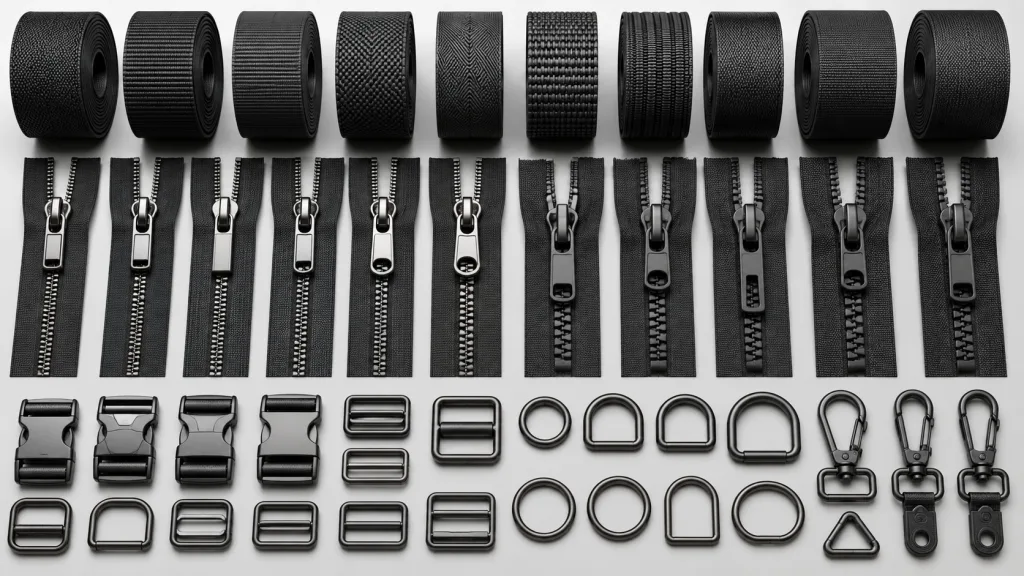
Today, Huayun Manufacturing has grown into a functional, comprehensive source factory capable of fully satisfying all accessory requirements across different industries and products. Its main product and service portfolio forms the following multi-dimensional functional matrix:
1. High-Precision Webbing Series: Covering high-end tactical nylon webbing with exceptional strength and wear resistance; polyester webbing with vibrant colors and excellent dimensional stability for fashion accessories; pure cotton webbing that is soft, skin-friendly, and eco-friendly; as well as jacquard webbing woven with computerized precision brand LOGOs and high-temperature flame-retardant special webbing.
2. Brand-Grade Zipper Series: Covering all materials such as nylon zippers, plastic Vislon zippers, and metal zippers. Utilizing our comprehensive supply chain, we achieve perfect color matching with zero metamerism color variance from zipper long chains and tape dyeing to customized sliders, ensuring a tight and smooth interlocking fit.
3. Bag Hardware and Engineered Buckles: Providing various specifications of alloy buckles, D-rings, tri-glide adjustment sliders, and plastic side-release buckles. All accessories undergo strict anti-corrosion and anti-rust surface treatments as well as high-load tensile strength destruction tests.
4. Global Recycled Standard (GRS Certified) Eco-Accessories: Aligning with the global low-carbon trend, we vigorously advance the R&D of eco-friendly circular webbing and zippers that meet international environmental protection standards, utilizing traceable recycled polyester raw materials to help brand clients directly overcome green trade barriers for foreign export markets.
V. Conclusion: Be Honest, Run the Factory Earnestly, and Weave the Quality Tomorrow of Chinese Manufacturing
From over three thousand years ago when ancestors painstakingly manipulated silk bands thread by thread on waist looms and manually hammered bronze belt hooks, to today’s modern, high-precision functional accessories fully matched under the high-efficiency collaboration of digital equipment and ERP systems in Guangzhou Huayun’s manufacturing workshop. This tiny accessory bond has experienced a disruptive metamorphosis from imperial aesthetics to secular daily life, and finally to modern polymer industrial supply chains. What changed are the speed of production tools and the physicochemical indicators of materials; what remains unchanged is the dedication of tangible accessory manufacturers to warp and weft tension and tight, seamless quality.
Guangzhou Huayun Manufacturing Co., Ltd. is located in Shiling Town, Huadu District, Guangzhou. Since its formal establishment on August 15, 2024, we have always focused on the R&D, production, and sales of webbing, zippers, and a full range of comprehensive accessories. If you are also suffering from headaches over sourcing materials everywhere, metamerism color variance, or mismatched specifications, and are looking for an experienced, reliable, high-quality, and GRS-certified one-stop source supplier for zippers and accessories, welcome to contact us via the website form, phone, or WeChat. We support customization based on samples, drawings, and specifications. To learn more about customized services and brand stories, welcome to visit the official website of Custom Webbing Manufacturer & Zipper Factory | Huayun for assistance. We look forward to sincere cooperation with you!
Guangzhou Huayun Manufacturing Co., Ltd. · Core Company Profile
| Full Factory Name | Guangzhou Huayun Manufacturing Co., Ltd. |
| Head Office Address | Shiling Town, Huadu District, Guangzhou — the Leather Goods Capital of China |
| Main Business | Research, development, production, and customization of webbing, zippers, and bag accessories. The main products include nylon webbing, polyester webbing, cotton webbing, PP webbing, jacquard and printed webbing, binding tape, elastic webbing, as well as nylon zippers, metal zippers, resin zippers, zippers specially designed for bags, and other products. |
| Cooperation and Contact | For customized webbing, zippers, or bag accessories, you are welcome to contact us through the website form, telephone, or WeChat. We support customization based on physical samples, drawings, and specifications. To learn more about our customized services and brand story, please visit the official website of Custom Webbing Manufacturer & Zipper Factory | Huayun of recycled webbing, zippers, and accessories. |