
In the entire history of modern synthetic polymer chemistry and modern creation, few man-made fibers have reshaped the face of global industry as thoroughly as nylon (Nylon, Polyamide PA). Today, when we pull open a lightweight and wear-resistant bag zipper, put on an outdoor backpack with excellent load-bearing capacity, fasten a car seat belt, or put on special protective clothing, we can touch this uniform, extremely high tensile strength legendary material everywhere. For many people, it may just be the most mundane basic raw material in industrial production; but if we pull our eyes back to the chemical laboratory nearly a century ago, you will be surprised to find that this narrow chemical fiber thread actually kicked off a grand prelude to humanity’s leap from relying on natural materials to the era of synthetic polymers. From the initial fashion miracle that solved the trouble of unlacing shoes and taking off silk stockings, to the strategic military supplies under the baptism of World War II, and now to the full industry matrix blessed by polymer modification technology, the century-long evolutionary history of nylon itself is a concentrated evolutionary history of modern industrial technology and modern global smart manufacturing supply chains.
I. The Synthetic Miracle in the Laboratory and the Initial Baptism of War: Carothers’ Wild Mania and the “Stocking Storm”
The birth of nylon originated from a forward-looking basic science bet funded by a corporate giant in the late 1920s. In 1928, the American company DuPont made a disruptive decision: to allocate special funds every year, not for short-term commercial interests, but purely to fund free exploration in the field of basic chemistry. They hired Wallace Carothers, a 32-year-old genius organic chemist from Harvard University, at a high salary to lead this work. At that time, the scientific community’s understanding of macromolecular structures was still in a state of confusion and controversy, while Carothers firmly believed that long-chain polymers similar to natural silk could be assembled honestly through the polycondensation of small molecules.
After seven full years of countless failures, explosions, and hard struggles, in 1935, Carothers’ team used hexamethylenediamine and adipic acid for polycondensation and finally successfully synthesized the first true fully synthetic fiber in human history—Polyamide 66. This material not only possesses extremely high mechanical tensile strength, fatigue resistance, and excellent wear resistance and durability that natural fibers cannot match, but can also be directly drawn into fine filaments through melt spinning. In 1938, DuPont officially announced this milestone achievement to the world and named it “Nylon,” marveling and praising it as “thin as cobwebs, strong as steel wire, and beautiful as silk.”

The first commercial release craze after nylon came out directly swept the entire fashion world. On May 15, 1940, the first batch of women’s stockings made of nylon fibers was officially launched in the United States, and millions of pairs were frantically snapped up within just one day. Because it was more wear-resistant, less prone to snagging, and extremely elastic compared to traditional real silk stockings, it quickly became a top fashion luxury item eagerly pursued by European and American socialites and ladies.
However, before this fashion storm could completely spread, the smoke of World War II completely broke the peace. With the outbreak of the war, because of its excellent physical tension and chemical resistance, nylon was immediately listed by the US government as the most core controlled strategic military supply. DuPont stopped production of all civilian stockings and honestly threw all its capacity into the military industrial battlefield. In that passionate era, nylon became the absolute main force for making military parachutes, bulletproof vest linings, tire cord fabrics for military off-road trucks, special glider tow ropes, and field military tents. The brutal baptism of war not only failed to destroy this new material, but instead verified the absolute reliability of nylon materials when bearing extreme high-strength mechanical tension in the most powerful way.
II. The Explosion of Material Science: The Multi-Dimensional Metamorphosis from a Single Polyamide to a Macromolecular Family
After the end of World War II, nylon technology, which had been tempered on the battlefield, rapidly flowed back to the civilian market, and along with the explosion of modern organic chemical engineering, ushered in a generational diversification in terms of material science. Scientists diversified the massive polyamide (PA) functional family by changing the carbon chain length and molecular structure of monomer molecules.
Among them, the most mainstream are Nylon 6 (PA6) and Nylon 66 (PA66). Nylon 6 is formed by the open-ring polymerization of polyamide monomers; its melting point is relatively low, its processing fluidity is excellent, and it has outstanding dye penetration and flexibility, quickly sweeping the civilian clothing, conventional carpet, and basic packaging film fields. Nylon 66, by virtue of its longer and tighter molecular chain symmetry, exhibits a higher melting point (about 260 degrees Celsius), higher hardness, better anti-creep capability, and heat friction resistance, making it the premier choice for the automotive industry, high-end mechanical transmission, and heavy-duty load-bearing accessories.
Subsequently, to meet the strict endurance requirements of special industries for extreme environments, long carbon chain nylons such as Nylon 11 and Nylon 12, as well as high-temperature nylon (PPA), were derived directionally. These materials can honestly fight without failing under extreme chemical scenarios such as severe cold, strong acids, strong alkalies, or heavy humidity while maintaining ultra-high dimensional stability under extremely low water absorption rates. Entering the 21st century, “modified nylon” filled with glass fibers (glass fiber reinforced modification), toughening agents, flame retardants, or anti-static agents into the nylon matrix has shone brilliantly, and its tensile strength even surpasses some non-ferrous metals, achieving the industrial feat of “replacing steel with plastic.”
III. Modern Multi-Dimensional Matrix: All-Scenario Product Applications From Clothing, Food, Housing, and Transportation to National Defense and Military Industry
Today, the application of modern nylon materials has woven a multi-dimensional functional matrix network spanning clothing, food, housing, transportation, and military. Its figure is everywhere, silently supporting the efficient operation of modern humanity:
- First, in the field of fashion clothing and civilian textiles, nylon (often called polyamide fiber) is the core skeleton of outdoor sports, quick-drying clothes and trousers, high-end yoga wear, trench coats, and jackets, as well as the outer shell of cold-resistant down jackets. Utilizing its excellent wear resistance and high elastic deformation recovery power, it allows the fabric to remain as good as new after repeated stretching and folding.
- Secondly, in the heavy automotive industry and modern mechanical engineering, modified engineering nylon is widely used in manufacturing car engine cylinder head covers, intake manifolds, high-load plastic gears, transmission shaft bearing sleeves, and fuel system quick-change connectors. Its large-area application not only greatly advances vehicle lightweighting and reduces fuel consumption, but also relies on its excellent oil-resistant insulation performance to guarantee the long-term stable operation of the power system.
- Furthermore, in the field of military defense and aerospace, specially modified nylon and nylon high-strength filaments are directionally processed into military tactical vest suspension systems, special helicopter rappelling slings, deep-sea ocean pelagic fishing nets, and lightweight structural connection pieces inside spacecraft, silently building a safety line under extreme tension loads.
IV. Focusing on Source Accessories Smart Manufacturing: Nylon’s Ultimate Hardcore Commitment in Modern Precision Webbing and Brand Zippers
Returning to the accessories manufacturing industry where we handle production and deal with supply chains every day, nylon materials occupy an irreplaceable dominant territory. The physicochemical quality of a raw nylon yarn directly determines the service life and grade texture of end bag and apparel products.
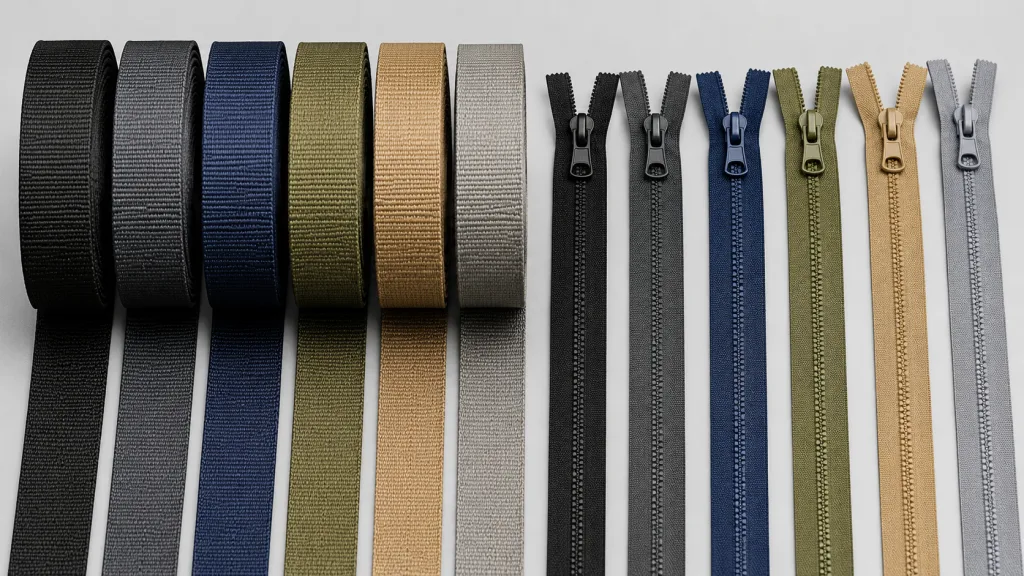
As a source factory deeply plowing the one-stop matching supply chain of zippers, webbing, and hardware for over twenty years, Guangzhou Huayun Manufacturing Co., Ltd. is honestly and steadily competing with the performance of nylon fibers every day on the land of Shiling Town, the capital of leather goods. For example, in our flagship high-precision [Nylon Webbing] series, selected high-polymer filament nylon raw yarns are tightly interwoven on high-speed shuttleless webbing looms with fully computerized precision electronic jacquard heads operating at thousands of cycles per minute. To meet the strict requirements of high-end climbing protection, special tactical backpacks, and luxury bags for heavy tensile loads, Huayun Manufacturing conducts full closed-loop testing on the entire width density, slip resistance, and physical anti-tearing limits of nylon webbing. As physical manufacturers, we don’t play virtual tricks; every meter of nylon webbing leaving the factory must pass rigorous tensile destructive data testing.
Similarly, in our [Nylon Zipper] and matching chain supply chain, polyester monofilaments are continuously wound and heat-set to form spiral nylon zipper teeth. This nylon spiral structure possesses natural lightweight characteristics, extremely high elastic recovery power, and a long life cycle under repeated opening and closing fatigue. Huayun Manufacturing relies on a mature matching supply chain to overcome the long-standing pain points of downstream manufacturers, such as severe metamerism (color jumping under different lighting) between nylon webbing and nylon zippers, and micro-deviation of specifications causing sliders to jam. We start with raw material dyeing processes and tooth arrangement accuracy to ensure that the slider and zipper teeth interlock tightly and smoothly, pulling smoothly from top to bottom in milliseconds.
More importantly, to help large numbers of bag and garment merchants who take foreign trade export channels to break through the green trade barriers of overseas high-end markets, Huayun Manufacturing conforms to the rigid trend of global sustainable development and vigorously promotes [Recycled Eco-friendly Nylon (Recycled Nylon)] that meets the Global Recycled Standard (GRS certification). We use traceable and recyclable recycled polymer fiber raw materials, combined with low-energy, pollution-free eco-friendly dyeing and finishing processes, honestly helping customers speak with samples and quality to jointly weave the green future of modern high-end Chinese manufacturing.
V. Conclusion: Be Honest in Business, Run the Factory Earnestly, and Weave the Quality Tomorrow of Chinese Manufacturing
From more than ninety years ago when Carothers pulled the first fragile synthetic polymer long chain from a test tube in the DuPont laboratory, to the parachute tow ropes that withstood the test of thunderous artillery fire on the battlefields of World War II, and now to the high-precision nylon accessory product matrix neatly arranged and displayed by region within the yellow safety lines in Huayun Manufacturing’s standard and smoothly running workshop. A tiny nylon fiber has experienced nearly a century of brilliant transformation. What changed are the speed of processing machinery and the physical protection boundaries of modification chemistry; what remains unchanged is the dedication and rigor of generations of physical manufacturing people toward process details and seamless, excellent quality.
The entire team of Guangzhou Huayun Manufacturing Co., Ltd. will always take roots at the forefront of accessories, strictly respecting every production detail as if walking on thin ice, and guarding the red lines of safety and quality. We will continue to grow side by side with the scientific logic of the younger generation using our twenty years of accumulated supply chain process heritage, being honest in business, running the factory earnestly, escorting your high-level products, and jointly weaving a more brilliant new future for China’s high-end smart manufacturing!
�� Core Physicochemical Properties Comparison Table of Common Engineering Nylons (PA6 vs PA66 vs Modified Nylon)
| Nylon 6 (Polyamide 6 / PA6) | Molecular Structure & Properties: Formed by the ring-opening polymerization of monomers, with a relatively loose molecular arrangement. Melting point is about 220 degrees Celsius. It has excellent processing fluidity, outstanding surface gloss, and dye penetration rate, with good flexibility. Core End Applications: Conventional civilian garment textiles, quick-drying shirts and pants, conventional carpet filaments, basic edge-binding tape weaving, food packaging films. |
| Nylon 66 (Polyamide 66 / PA66) | Molecular Structure & Properties: Formed by the polycondensation of hexamethylenediamine and adipic acid, with extremely high molecular chain symmetry. Melting point is about 260 degrees Celsius. It features strong hardness, extremely high wear resistance, and anti-creep capability; its resistance to heat wear and mechanical tensile limit are significantly superior to PA6. Core End Applications: High-end heavy-duty bag straps, high-strength tactical nylon webbing, car seat belts, brand-grade high-longevity zippers, high-load industrial gears and bearings. |
| Modified Reinforced Nylon (e.g., PA66 + Glass Fiber / Flame Retardant) | Molecular Structure & Properties: Filled with a high proportion of glass fiber, toughening agents, or electromagnetic flame retardants within the nylon matrix. The mechanical tensile and shear strength increase exponentially, providing excellent high-temperature thermal deformation resistance and metal-replacing properties. Core End Applications: Car engine cylinder head covers, intake manifolds, aerospace structural connectors, military tactical defense hanging components, special high-flame-retardant fire safety field equipment. |