
The Past and Present of Webbing and Its Technological Transformation
Throughout the long evolution of human civilization and the history of making objects, the ways in which clothing and equipment have been connected and reinforced directly reflect the generational development of production tools.
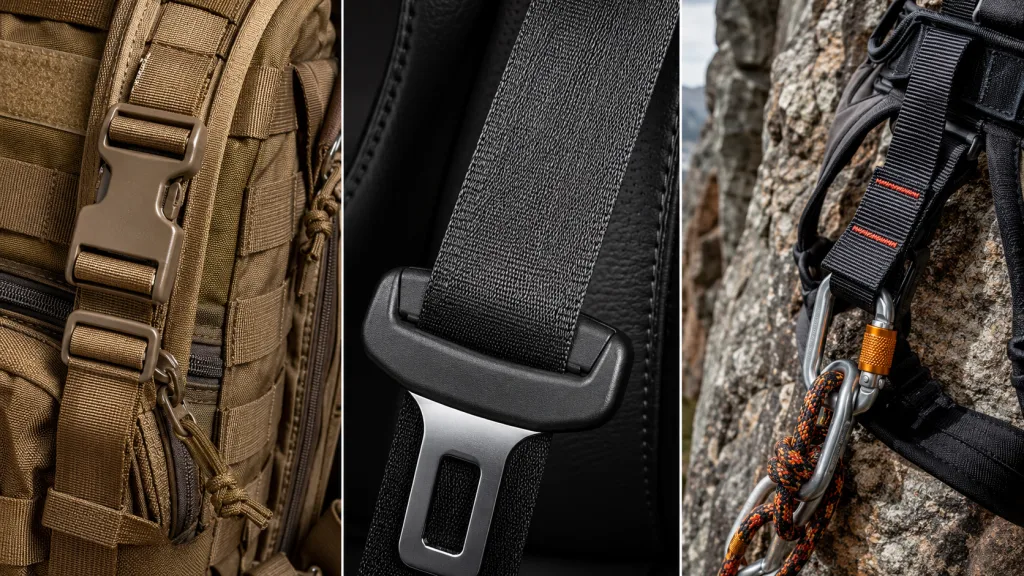
Today, when we walk through markets filled with bag and luggage accessories, or encounter climbing protection equipment, automotive safety belts and military tactical gear, we can see modern webbing everywhere. These narrow woven bands have uniform textures and extremely high tensile strength.
To many people, webbing may seem like nothing more than an ordinary industrial accessory. However, when we extend our view across history, we discover that this narrow strip of material has travelled through more than three thousand years of technological change.
It developed from primitive knotted cords and hand-braided silk bands into ceremonial waistbands that represented social rank during the imperial dynasties. It then entered the age of geared shuttle looms during the Industrial Revolution before finally evolving into today’s digitally managed industrial matrix supported by advanced polymer materials.
The development of webbing is itself a condensed history of technological progress in the textile industries of China and the wider world.
I. From Prehistoric Times to the Qin and Han Dynasties: From Knotted Waist Cords to the Social Aesthetics of Silk Bands
The earliest forms of webbing can be traced back to primitive hand-braiding techniques from the Neolithic period.
Before human beings had mastered complex weaving machines, early communities collected natural plant bast fibers, including hemp and kudzu vine, as well as animal hair. To secure animal skins, protect themselves from the cold and reinforce the tools they carried, they crossed, knotted, twisted and braided these fibers by hand into the earliest cords and narrow bands.
These were the physical ancestors of webbing.
During the Shang and Zhou dynasties and the Qin and Han periods, the appearance of bronze textile tools and the development of the Silk Road brought the first major technological advance in the weaving of narrow fabrics.
In ancient documents, these products were commonly described by terms such as tao, dai, zu and fu, referring to different forms of cords, bands, braided ribbons and ceremonial sashes.
At that time, webbing was mainly produced with a hand-operated backstrap loom, in which one end of the warp was tied around the weaver’s waist and tension was controlled by the body. Another method was tablet weaving, an ancient technique in which perforated cards were rotated to interlace the warp threads.
Because these processes were extremely complicated and production quantities were very limited, silk-woven bands with different colors and intricate patterns became important political symbols within the ceremonial system of the Zhou dynasty.
These woven silk ribbons and seal cords were used to distinguish official rank and demonstrate differences in social status.
The fastening cords on the crowns of emperors and senior officials, the ribbons used to carry official seals and the decorative edging on leather waistbands were all carefully woven by hand from fine silk. Their structures were dense, and their colors remained vivid for long periods.
During this period, webbing evolved from a purely practical reinforcing tool into an important element of ceremonial aesthetics associated with the upper levels of imperial society.
II. From the Tang and Song Dynasties to the Ming and Qing Dynasties: The Spread of Wooden Shuttle Looms and the Growth of the Folk Accessory Industry
As history entered the prosperous Tang and Song periods, the growth of the commodity economy greatly increased public demand for textiles.
Webbing production gradually moved beyond government-operated workshops and entered wider civilian markets.
Improvements made by Huang Daopo to cotton-spinning and weaving technologies allowed cotton yarn to replace some of the more expensive silk materials and become an important raw material for large-scale weaving.
During this period, hand-operated wooden shuttle looms capable of producing several narrow bands at the same time became widely developed and used in civilian workshops. These machines were commonly known as multi-ribbon looms.
The wooden machinery used foot pedals to control the opening of the warp. The weaver inserted the shuttle by hand to carry the weft yarn across the warp, allowing several or even more than ten ribbons, shoelaces or decorative braids of the same specification to be woven simultaneously on one machine.
This advance in production equipment increased webbing-manufacturing efficiency dramatically.
During the Ming and Qing dynasties, specialized ribbon and braid businesses appeared in regions south of the Yangtze River, including Suzhou, Hangzhou and Huzhou. These businesses focused on producing narrow decorative edging, garment binding, waistbands and bands used for handkerchiefs.
The functions of webbing also became more widespread and closely connected with ordinary life.
Webbing was no longer only a symbol of political authority used in imperial halls. It became an everyday necessity in ordinary households.
It was used for fastening shoes and boots, securing horse-drawn carriages and sedan chairs, tying bedding and decorating women’s clothing with embroidered braids and binding.
Countless warp and weft threads, honestly interlaced by shuttle looms, supported both the refinement and the everyday vitality of traditional Chinese life.
III. The Modern Industrial Revolution: The Technological Leap from Steam-Powered Gears to High-Speed Shuttleless Looms
The quiet world of traditional hand weaving and wooden webbing looms was completely disrupted by the roar of the mechanical Industrial Revolution during the nineteenth century.
The development of mechanized textile technology in the West introduced powered shuttle webbing looms.
Driven by steam engines or electric motors, these machines used complex cast-iron gear transmissions and crank-and-connecting-rod mechanisms to automate shuttle movement and weft beating, greatly reducing the need for manual labor.
At the beginning of the twentieth century, China gradually introduced these modern industrial webbing machines through coastal commercial ports such as Shanghai and Guangzhou.
This marked the beginning of a difficult industrial transformation for China’s domestic textile-accessory industry.
However, traditional shuttle looms used large wooden or plastic shuttles. Their heavy reciprocating movement created significant inertia, physically limiting production speed while also generating extremely loud noise.
By the middle of the twentieth century, the global textile industry experienced a disruptive technological revolution with the invention of the shuttleless webbing loom.
Shuttleless looms completely eliminated the heavy shuttle. Instead, they used lightweight rapiers, air jets or hooked needles to carry the weft yarn directly into the open warp shed.
This technological breakthrough increased the operating speed of webbing machines from only dozens of reciprocating movements per minute to hundreds or even more than one thousand movements per minute.
Both production efficiency and the flatness of narrow woven fabrics improved dramatically.
The later introduction of fully computerized precision jacquard technology gave webbing manufacturing the ability to enter the age of intelligent production.
In the past, complex jacquard patterns required workers to assemble cardboard pattern cards one by one.
Today, digital designs can be created directly in computer software and transmitted through a data cable to the electronic jacquard head of the webbing machine.
Under the precise control of electromagnetic valves, hundreds or thousands of extremely fine raw yarns can interlace at high speed thousands of times per minute.
This allows three-dimensional brand logos and highly detailed patterns with clear visual layers to be woven accurately into the narrow surface of the webbing.
IV. The Modern Multidimensional Matrix: Functional Applications Across Industries Supported by Advanced Materials
Today, the meaning and application of modern webbing have changed fundamentally.
Webbing is no longer limited to the simple fastening and decoration of traditional clothing, hats, shoes and socks.
Supported by advanced materials and polymer chemistry, it has developed into a functional connecting structure used across many industries, including military equipment, aerospace, automotive manufacturing, medical applications and extreme outdoor sports.
From the perspective of material development, modern webbing has completed a broad transformation toward high-technology and high-tensile-strength applications.
1. Nylon Webbing
Nylon webbing provides high strength and excellent abrasion resistance. It is suitable for outdoor products and bag shoulder straps.
Nylon itself offers outstanding resistance to tearing and has a fine natural sheen.
It can withstand high levels of mechanical tension, making it a preferred material for premium tactical backpacks, mountaineering equipment and specialized protective gear.
2. Polyester Webbing
Polyester webbing offers bright colors and strong resistance to fading. It is widely used in fashion accessories.
Polyester has excellent shape retention and resistance to sunlight.
In both dry and wet conditions, it maintains outstanding wrinkle resistance and structural stability, allowing it to present complex and highly saturated color combinations effectively.
3. Cotton and Functional Specialty Webbing
Cotton webbing is produced from carefully selected, high-count and high-density natural cotton. It is mainly used for skin-friendly applications and customized products with a vintage appearance.
For extreme industrial environments, several specialized materials have also been developed.
These include aramid webbing with strong flame-resistant properties and resistance to temperatures of several thousand degrees, Kevlar webbing for ballistic, puncture and cutting protection, and advanced functional accessories with antistatic, high-strength reflective and other physical or chemical protective properties.
4. Green and Recycled Webbing
To meet the mandatory environmental requirements created by global sustainable development, the industry is comprehensively advancing recycled ecological webbing that complies with the Global Recycled Standard and GRS certification requirements.
These products use traceable and recyclable polyester fibers together with low-energy and non-polluting dyeing and finishing processes.
This directly helps many bag, luggage and apparel customers engaged in international trade overcome the environmental access requirements of premium overseas markets.
V. Conclusion: Inheriting the Craftsmanship of Countless Threads and Weaving a Higher Standard of Modern Intelligent Manufacturing
More than three thousand years ago, ancient craftspeople patiently manipulated individual silk threads on backstrap looms to produce decorative bands and ceremonial ribbons.
Today, high-precision functional webbing flows from the machines in the Guangzhou Huayun Manufacturing workshop at more than one thousand high-speed reciprocating movements per minute, supported by digital management and ERP production scheduling.
This small and narrow accessory has experienced a transformation from handwoven aesthetics and the everyday life of traditional communities to the modern industrial network of advanced polymer materials.
What has changed is the speed of production equipment and the physical and chemical performance of fiber materials.
What has remained unchanged is the dedication of generation after generation of textile-accessory manufacturers to controlling warp-and-weft tension and maintaining precisely fitted, dependable quality.
Guangzhou Huayun Manufacturing Co., Ltd. is located at No. 16-1, Lane 1, Zhenxing Longtianmian, Zhenxing Village, Shiling Town, Huadu District, Guangzhou.
We have always believed that although accessories may be small, the responsibility behind them is significant.
If you are struggling to source matching materials from different suppliers, facing incompatible specifications or dealing with color differences in bulk production, and you are looking for an experienced, dependable and quality-focused source supplier of accessories, you are welcome to visit the official website of Guangzhou Huayun Manufacturing Co., Ltd., a GRS-certified OEM and ODM source factory for recycled webbing, zippers and accessories.
We do not rely on empty promises.
We allow physical samples and dependable quality to speak for us.
We look forward to sincere cooperation with you.
Huayun Manufacturing — Weaving Quality, Leading the Future!