
In modern daily life, zippers are almost as omnipresent as air.
Whether on the clothes we put on and take off every day, the bags and luggage we carry, specialized protective clothing or outdoor tents, a gentle pull can complete opening or closing within milliseconds.
This extraordinary convenience often causes people to overlook the true significance of the zipper as one of the greatest mechanical inventions of modern times.
What appears to be nothing more than two fabric tapes and hundreds of interlocking teeth is actually the result of more than a century of developments in mechanical engineering and materials science.
From the crude iron hook fastener originally created to eliminate the trouble of tying shoelaces, to a fashion accessory used throughout the world, and finally to today’s functional, environmentally responsible and precisely manufactured products, the history of the zipper is itself a remarkable story of modern industrial design and supply-chain transformation.
I. The Beginning of an Idea and a Difficult Birth: A Mechanical Vision to Eliminate the Trouble of Fastening Boots
Before the zipper appeared, human society had relied for thousands of years on several main methods for closing clothing, including buttons, laces, hooks and pins.
By the middle of the nineteenth century, as the Industrial Revolution expanded across Europe and the United States, footwear and clothing styles became increasingly complicated.
One popular style among European and American gentlemen at the time was a tall, tight-fitting leather boot covered with many closely arranged buttons.
Putting on or removing one pair could take more than ten minutes and sometimes required a special tool known as a buttonhook.
This extremely inconvenient experience became the original motivation behind the invention of the zipper.
In 1851, Elias Howe, the inventor of the sewing machine, was the first to apply for a patent for an “Automatic, Continuous Clothing Closure.”
However, because his sewing-machine business was already highly successful, he did not develop the invention for commercial production.
The person who truly brought an early zipper design to the market was the American engineer Whitcomb Judson.
During the 1890s, Judson spent several years trying to help a friend who suffered from back pain and could not bend down to tie his shoelaces.
In 1893, he designed a closing chain made from a series of interlocking eyelets and metal hooks and named it the “Clasp Locker.”
However, Judson’s first-generation invention was a commercial failure.
Because precision mechanical processing was still extremely limited at that time, the metal-hook chain was heavy and easily rusted.
More seriously, it could suddenly burst open when bent, creating embarrassing situations for the men and women who wore it in public.
At the 1893 Chicago World’s Fair, only a few dozen of Judson’s fasteners were sold.
Nevertheless, the invention clearly showed future engineers the correct direction: a mechanical system in which a slider could create continuous closure had already become possible.
II. The Perfect Interlocking Structure and the Name “Zipper”: From an Engineering Breakthrough to Widespread Military Use
The mature physical structure of the modern zipper is largely credited to Gideon Sundback, a Swedish-born electrical engineer who worked for Judson’s company.
Sundback clearly recognized the natural weaknesses of Judson’s metal-hook structure.
He abandoned the hooks and replaced them with a system of small interlocking teeth featuring matching raised and recessed sections.
In 1913, Sundback developed the famous Hookless Fastener No. 2.
He concentrated intensely on improving mechanical precision, increasing the density of the teeth from four per inch to more than ten per inch.
Through stamping technology, each metal tooth was formed with a small raised section at the top and a corresponding recessed section at the bottom.
When the slider passed over the teeth, the two sides were guided together at a precise angle and locked firmly into place.
This invention completely solved the most serious problems of earlier fasteners, including unexpected opening and frequent jamming, and established the fundamental mechanical structure of the modern zipper.
Once the structure had matured, commercial success soon followed.
In 1923, the American company B.F. Goodrich began using Sundback’s improved fastener on a rubber boot.
When the slider was pulled, the interlocking teeth produced a clear and satisfying “zip” sound.
Inspired by the sound, the company’s president used it as the product name and registered the modern trademark Zipper.
From that point onward, the name became widely recognized.
The outbreak of the First World War unexpectedly accelerated the adoption of the zipper.
The United States military discovered that this new closing device could greatly improve the speed at which soldiers prepared and responded on the battlefield.
It was therefore included in military procurement and used extensively on pilot jackets, naval windproof clothing, sleeping bags and large quantities of military canvas money pouches.
After the war, tens of thousands of returning soldiers brought zipper-equipped uniforms back into civilian life, quickly helping the zipper become a fashionable and practical product.
During the 1930s, Parisian haute-couture designers introduced zippers into women’s clothing, while the Prince of Wales in Britain adopted zippers in trouser flies as a replacement for traditional buttons.
The zipper had finally completed its transformation from a mechanical novelty into one of the most important textile accessories in the world.
III. The Materials Revolution: The Evolution from Solid Metal Teeth to a Complete Polymer-Based Product Matrix
With the rapid development of modern chemistry and materials science, zippers moved beyond the age in which iron, copper and other metals were the only available materials.
Three major material families gradually emerged, creating the multidimensional product matrix used today to meet the requirements of different industries and tensile-strength specifications.
1. Metal Zippers
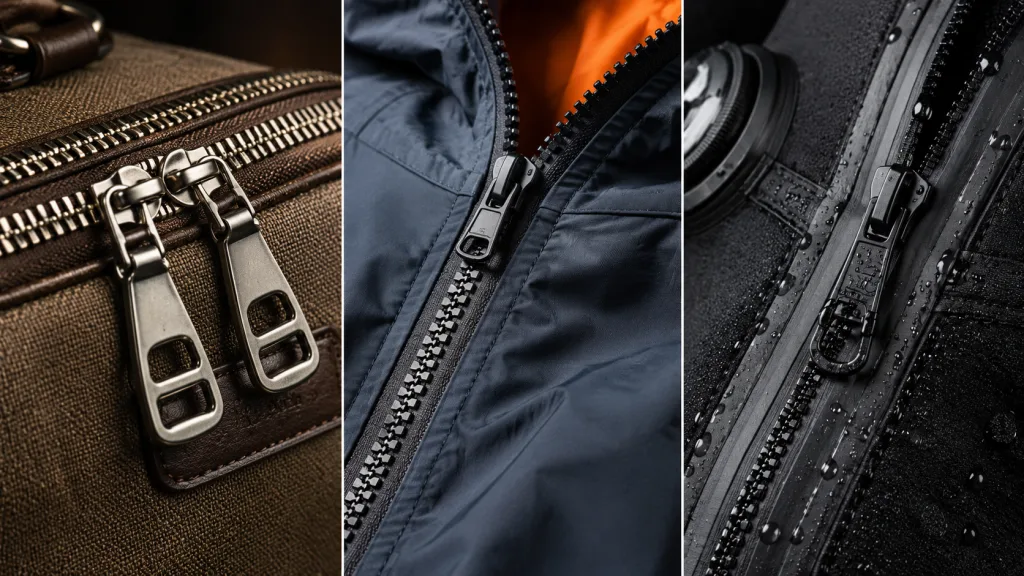
As the oldest zipper family, modern metal zippers are produced with high-precision tooth-forming machines.
Strips of copper, aluminum, stainless steel or zinc alloy are stamped into individual teeth and firmly attached to the fabric tape.
Metal zippers provide high tensile strength and a strong, substantial appearance.
They remain a standard choice for jeans, vintage leather jackets and premium heavy-duty bags and luggage.
2. Nylon Coil Zippers
During the middle of the twentieth century, polymer polyester materials became widely available.
Engineers used continuously wound polyester monofilament, commonly referred to as nylon filament, and formed it into spiral-shaped zipper elements through heat setting.
Nylon coil zippers are extremely lightweight, highly flexible and strongly resistant to repeated bending and fatigue.
They also offer excellent cost efficiency.
As a result, they quickly became widely used in sportswear, lightweight backpacks, bedding and general household products.
Today, nylon coil zippers are the largest-volume zipper category in the global market.
3. Plastic Vislon Zippers
Plastic Vislon zippers are manufactured from engineering plastics such as polyoxymethylene, commonly known as POM.
Using precision molds, molten plastic is injected directly onto the edges of the zipper tape to form the teeth.
The teeth are full and rounded, resistant to corrosion and capable of withstanding exposure to seawater.
They can also be produced in a wide range of bright and attractive colors.
Plastic Vislon zippers are therefore widely used in outdoor jackets, cold-weather clothing and water-sports equipment.
IV. The Modern Functional Matrix: Breaking Through Performance Barriers and Building the Digital Future of Source Manufacturing
After entering the twenty-first century, the processing precision and technical limits of modern zippers continued to advance.
Zippers are no longer expected merely to open and close.
Supported by precise quality control, they have overcome one specialized functional barrier after another.
Airtight and Waterproof Zippers
Airtight waterproof zippers are produced by thermally applying waterproof polymer coatings such as PU, TPU or PVC to the surface of a nylon zipper.
When the zipper is closed, the teeth are completely covered by the coating.
This creates excellent airtightness and prevents water penetration even under substantial pressure.
These zippers are essential components in premium diving suits, polar outdoor jackets, heavy-rain backpacks and military rescue equipment.
Flame-Resistant and High-Temperature Zippers
Flame-resistant zippers use specialized aramid webbing combined with heat-resistant zinc-alloy teeth.
They are designed to maintain their structure without melting or jamming in extremely high-temperature fire environments, providing important protection for firefighters and specialized industrial workers.
Green Recycled Zippers
To meet the strict environmental requirements created by global sustainable-development policies, the industry is increasingly adopting recycled zippers that comply with the Global Recycled Standard and GRS certification requirements.
From the recycled polyester tape to the recycled injection-molded teeth, the entire production process can be traced.
These products help international brands and export customers meet the environmental-entry requirements of overseas markets.
Guangzhou Huayun Manufacturing Co., Ltd. is located at No. 16-1, Lane 1, Zhenxing Longtianmian, Zhenxing Village, Shiling Town, Huadu District, Guangzhou.
As a professional source factory for accessories and zippers, we have accumulated more than twenty years of experience in production processes and supporting supply chains.
We clearly understand the most common difficulties faced by downstream manufacturers during purchasing:
The webbing and zipper colors may not match.
Serious metameric color differences may appear under different lighting conditions.
The slider may not move smoothly along the continuous zipper chain.
Even a slight difference in specifications may cause jamming during assembly.
To help customers resolve these quality concerns completely, Guangzhou Huayun Manufacturing Co., Ltd. has established a comprehensive high-standard quality-control system and a coordinated one-stop supply chain.
Whether a customer provides a physical webbing sample for high-precision replication or a three-dimensional design drawing for product development, we can support the development process.
Customers who are struggling to source matching materials from different suppliers, dealing with incompatible specifications or facing color differences in bulk production are welcome to contact Guangzhou Huayun Manufacturing Co., Ltd., a GRS-certified source factory providing OEM and ODM manufacturing of recycled webbing, zippers and accessories.
We do not rely on empty promises.
We allow physical samples and dependable quality to speak for us.
We look forward to sincere cooperation with you.
Through the craftsmanship and strength of our complete supply chain, we help protect the quality of your high-standard products.
Huayun Manufacturing — Weaving Quality, Leading the Future!